


Martens Centre
  • Home
  • About
    • Who we are
    • Team
    • Bodies and Experts
    • Members
  • Publications
  • Events
  • News
  • Blog
  • Contact
back

Publications

  • Home
  • About
    • Who we are
    • Team
    • Bodies and Experts
    • Members
  • Publications
  • Events
  • News
  • Blog
  • Contact
Share this...
  • Facebook
  • Twitter
  • Linkedin
  • Email

Regulating the Digital Future: A Centre–Right Approach to Crypto Assets and Digital Currencies

27 April 2022

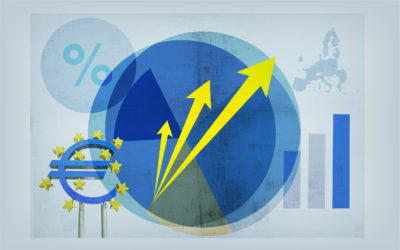
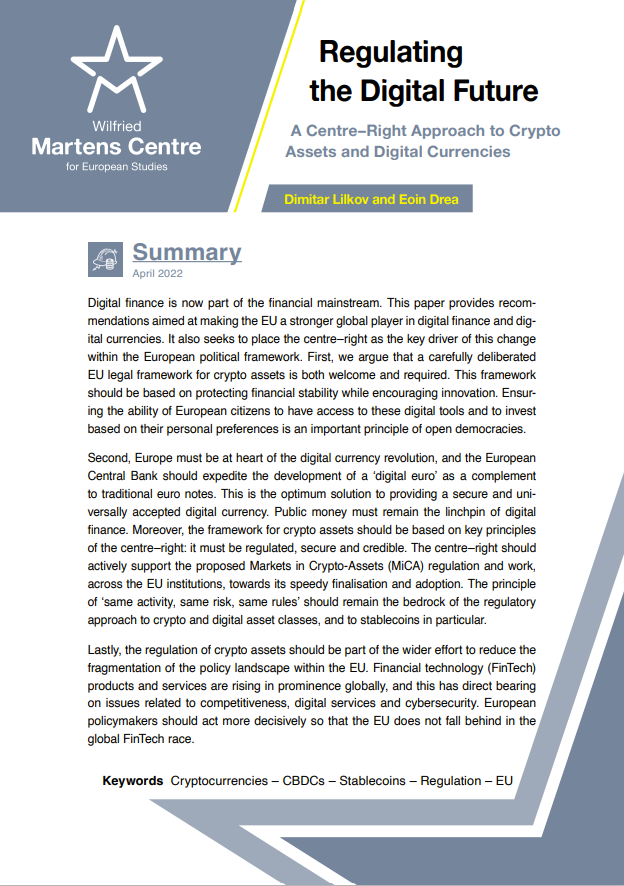
Digital finance is now part of the financial mainstream. This paper provides recommendations aimed at making the EU a stronger global player in digital finance and digital currencies. It also seeks to place the centre–right as the key driver of this change within the European political framework. First, we argue that a carefully deliberated EU legal framework for crypto assets is both welcome and required. This framework should be based on protecting financial stability while encouraging innovation. Ensuring the ability of European citizens to have access to these digital tools and to invest based on their personal preferences is an important principle of open democracies.

Second, Europe must be at the heart of the digital currency revolution, and the European Central Bank should expedite the development of a ‘digital euro’ as a complement to traditional euro notes. This is the optimum solution to providing a secure and universally accepted digital currency. Public money must remain the linchpin of digital finance. Moreover, the framework for crypto assets should be based on key principles of the centre–right: it must be regulated, secure and credible. The centre–right should actively support the proposed Markets in Crypto-Assets (MiCA) regulation and work, across the EU institutions, towards its speedy finalisation and adoption. The principle of ‘same activity, same risk, same rules’ should remain the bedrock of the regulatory approach to crypto and digital asset classes, and to stablecoins in particular.

Lastly, the regulation of crypto assets should be part of the wider effort to reduce the fragmentation of the policy landscape within the EU. Financial technology (FinTech) products and services are rising in prominence globally, and this has direct bearing on issues related to competitiveness, digital services and cybersecurity. European policymakers should act more decisively so that the EU does not fall behind in the global FinTech race.

ENJOYING THIS CONTENT?
Stay up to date by joining our database !
Download the publication
See the publication in a flipbook
Regulating the Digital Future: A Centre–Right Approach to Crypto Assets and Digital Currencies

Policy Briefs

Eoin Drea

Dimitar Lilkov

Related events

  • Regulating the Digital Future: Can Europe Lead the Crypto and Digital Currencies Revolution?

    10 May 2022

  • Digital
  • Economy
  • Technology

Related publications

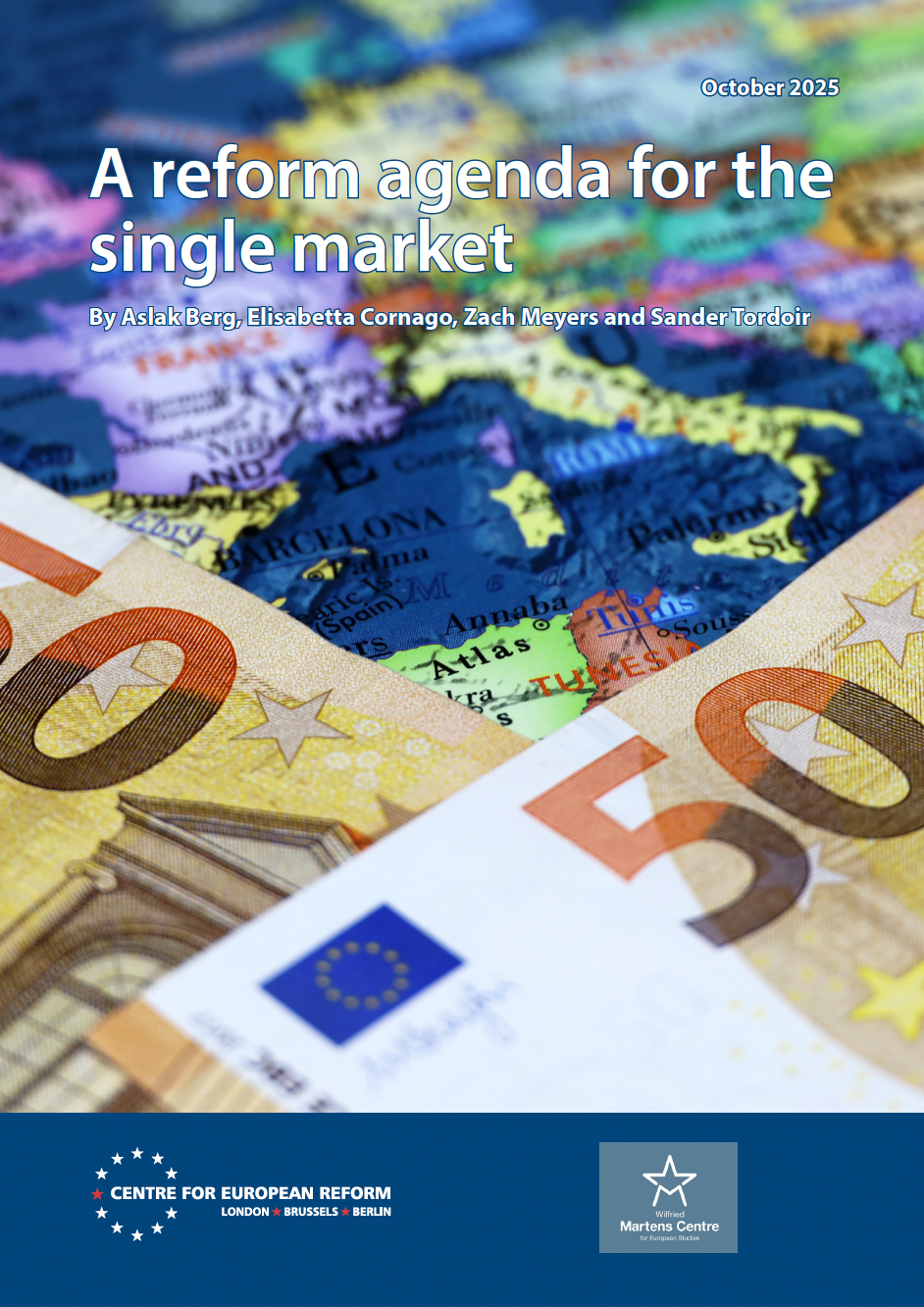
  • A reform agenda for the single market

    Other

    A reform agenda for the single market

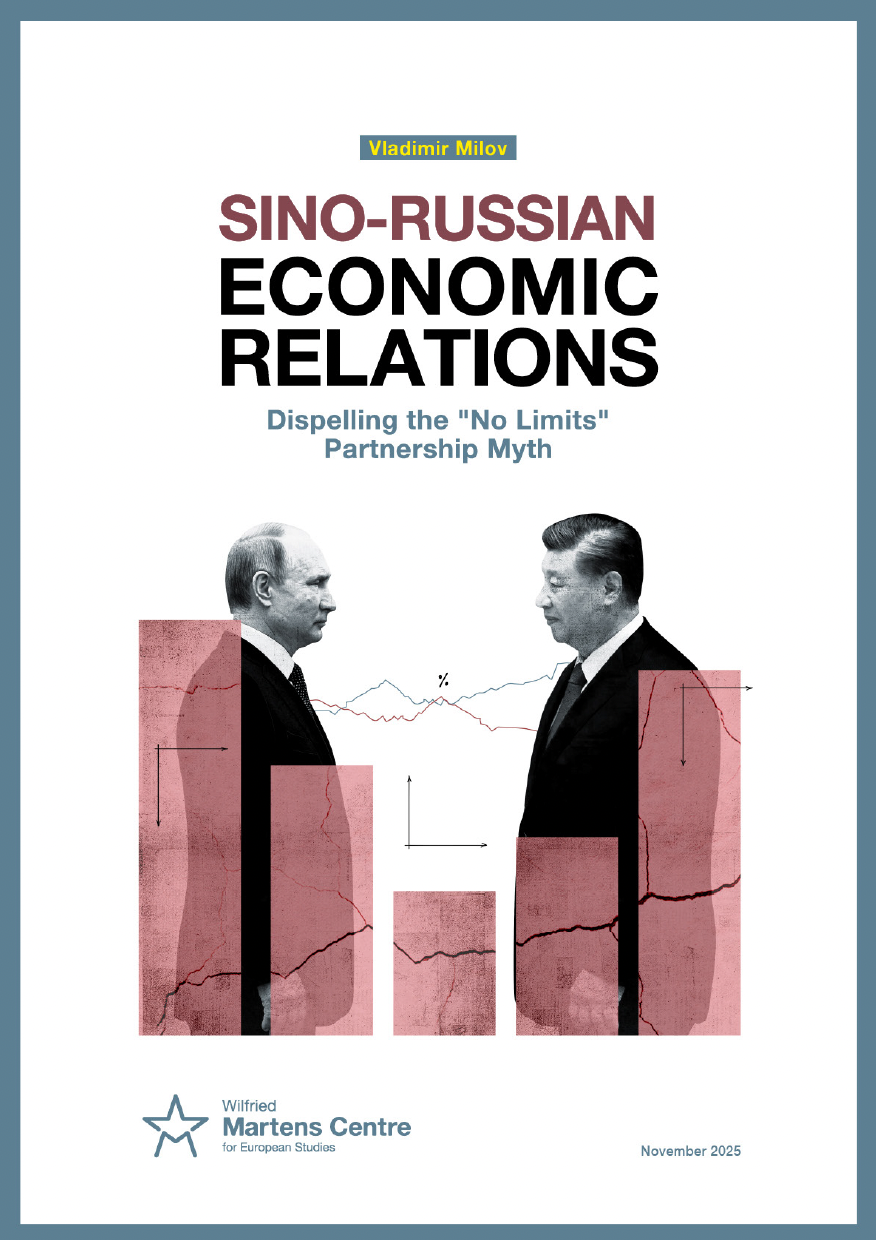
  • Sino-Russian Economic Relations: Dispelling the “No Limits” Partnership Myth
    Other

    Sino-Russian Economic Relations: Dispelling the “No Limits” Partnership Myth

  • Working Migrants Valued for Their Economic Contribution

    Other

    Working Migrants Valued for Their Economic Contribution

  • Strategic Policy Recommendations for the European People’s Party

    Other

    Strategic Policy Recommendations for the European People’s Party

  • Horizon: Competitiveness – How FP10 Can Unlock Europe’s Collective Intelligence for Science, Competitiveness and Strategic Autonomy

    Policy Briefs

    Horizon: Competitiveness – How FP10 Can Unlock Europe’s Collective Intelligence for Science, Competitiveness and Strategic Autonomy

  • Towards a New Order? The Economic Programmes of Right-Wing Populist Parties

    Research Papers

    Towards a New Order? The Economic Programmes of Right-Wing Populist Parties

  • From Taiwan to Malaysia: The Silicon Alley of the East

    Other

    From Taiwan to Malaysia: The Silicon Alley of the East

  • China’s Electric Vehicle Challenge to Europe: Red Flags and Red Lines

    Policy Briefs

    China’s Electric Vehicle Challenge to Europe: Red Flags and Red Lines

You might also be interested by

  • Recharging Europe’s Competitiveness: Why the EU Needs a European Productivity Board

    Blog

    21 Jan 2026

  • Europe’s Single Market: Why Aviation Shows the Way | Op-ed Ep.9

    Video Op-Eds

    20 Jan 2026

  • Economic Growth is Europe’s Best Defence

    Blog

    14 Jan 2026

  • Venezuela Post-Maduro: Meeting the Challenge of Reconstruction

    Blog

    12 Jan 2026

  • Can 2026 reset EU-UK relation? – Bridge the Channel ep20

    Bridge the Channel - Multimedia

    15 Dec 2025

  • France and the Sick Men of Europe

    Blog

    10 Sep 2025

  • Europe’s Competitiveness Compass is Pointing in the Right Direction – But it Overlooks the Workforce Crisis

    Blog

    04 Feb 2025

  • Friend or Foe? An Economic War With the U.S. Should Inspire Greater Canadian Autonomy

    Blog

    30 Jan 2025

  • It’s the Economy or Bust for Europe’s Centre Right in 2025

    Blog

    07 Jan 2025

  • On Revenants in Economic Policy: Taxing the Rich

    Blog

    31 Oct 2024

Related events

    • 09 November 2023

      Publication Launch: Middle-Class Concerns and European Challenges

      Publication Launch: Middle-Class Concerns and European Challenges

      ACE Events, Avenue d’Auderghem 22,1040 Brussels

      In-House Events

    • 10 - 11 October 2023

      European Ideas Forum 2023

      European Ideas Forum 2023

      DoubleTree by Hilton, Brussels

      In-House Events

Stay updated on Martens Centre Activities, Events and Publications

  • Navigate

    • Home
    • About
      • Who we are
      • Team
      • Bodies and Experts
      • Members
    • Publications
    • Events
    • News
    • Blog
    • Contact
  • More

    • A word from Wilfried Martens
    • European People’s Party
    • Join the team
    • Privacy Policy, Cookie policy & Legal
  • Contact us

    0032 (0)2 300 80 04
    20 Rue du Commerce
    1000 Brussels, Belgium

  • The activities of the Martens Centre receive financial support from the European Parliament. The European Parliament assumes no liability for the Martens Centre’s activities, the content of its publications, or the opinions expressed therein, nor for their subsequent use.

Copyright © 2026 | Martens Centre ALYS

Manage Cookie Consent
To provide the best experiences, we use technologies like cookies to store and/or access device information.
Functional Always active
The technical storage or access is strictly necessary for the legitimate purpose of enabling the use of a specific service explicitly requested by the subscriber or user, or for the sole purpose of carrying out the transmission of a communication over an electronic communications network.
Preferences
The technical storage or access is necessary for the legitimate purpose of storing preferences that are not requested by the subscriber or user.
Statistics
The technical storage or access that is used exclusively for statistical purposes. The technical storage or access that is used exclusively for anonymous statistical purposes. Without a subpoena, voluntary compliance on the part of your Internet Service Provider, or additional records from a third party, information stored or retrieved for this purpose alone cannot usually be used to identify you.
Marketing
The technical storage or access is required to create user profiles to send advertising, or to track the user on a website or across several websites for similar marketing purposes.
  • Manage options
  • Manage services
  • Manage {vendor_count} vendors
  • Read more about these purposes
View preferences
  • {title}
  • {title}
  • {title}
Go to mobile version