


Martens Centre
  • Home
  • About
    • Who we are
    • Team
    • Bodies and Experts
    • Members
  • Publications
  • Events
  • News
  • Blog
  • Contact
back

Publications

  • Home
  • About
    • Who we are
    • Team
    • Bodies and Experts
    • Members
  • Publications
  • Events
  • News
  • Blog
  • Contact
Share this...
  • Facebook
  • Twitter
  • Linkedin
  • Email

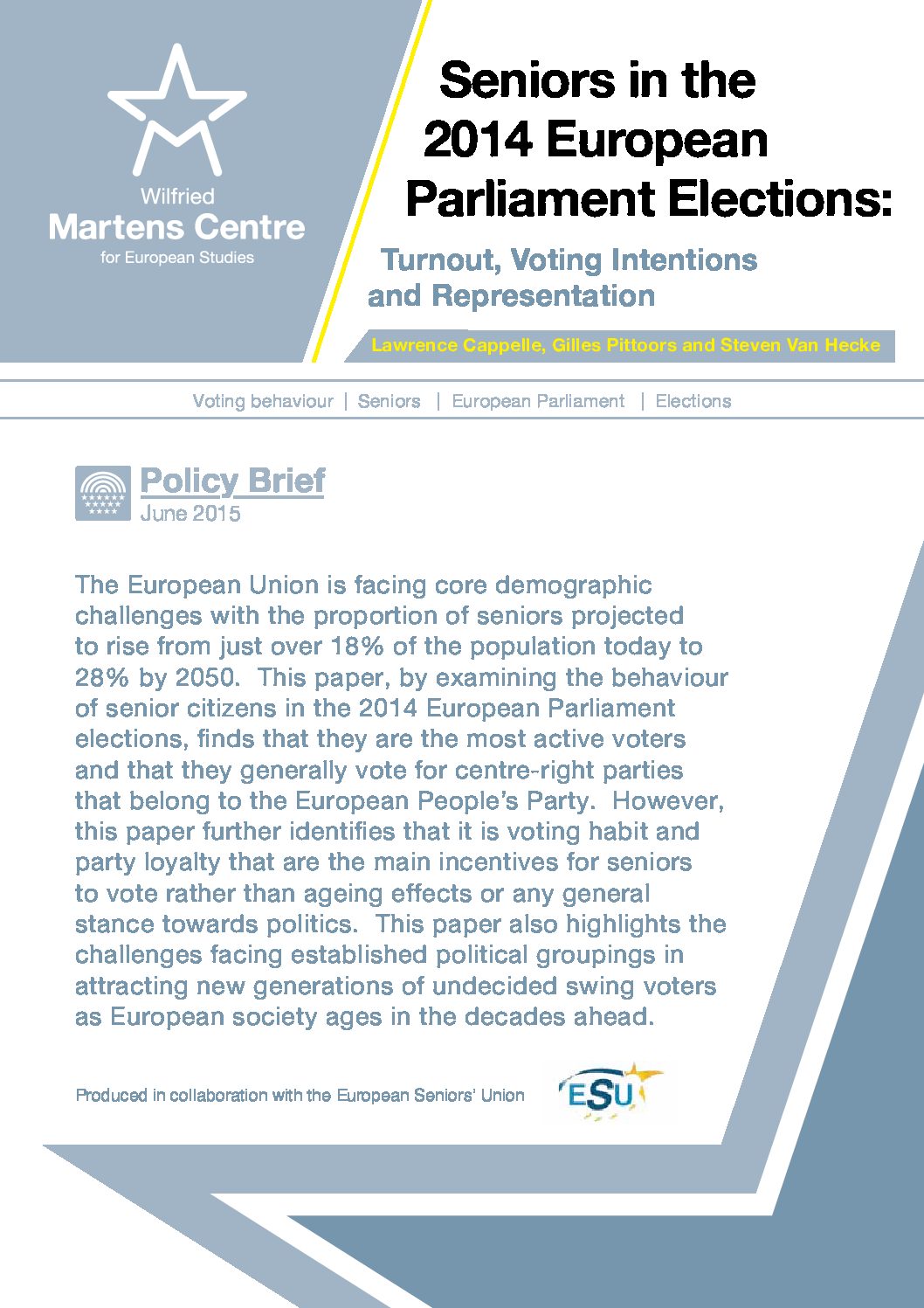
Seniors in the 2014 European Parliament Elections: Turnout, Voting Intentions and Representation

01 July 2015

The European Union as a whole has seen the share of the elderly population rise progressively. Over 18% of the population is currently aged 65 years or over, a figure that has risen by 2% over the last ten years and is expected to increase to 28% by 2050. This trend holds across all of Europe. Confronted with demographic ageing, the question arises as to whether this changing structure of the population is also having an impact on politics and elections. Despite the increasing share of seniors in society, few if any studies have focused on seniors’ voting behaviour.

This paper aims to examine the voting behaviour of European senior citizens in the 2014 European Parliament (EP) elections. It is structured along three main questions. The first part will deal with the question of whether and how the increasing share of seniors in the overall population affects voter turnout in elections, considering age, generational effects and political knowledge and opinion as the main explanations.

The second part deals with the question of whether and how the increasing share of seniors in the overall population affects election results, considering political opinion and party loyalty as main explanations. The third and final part will assess the representation of seniors in the EP, 
considering the share of senior Members of the European Parliament (MEPs) and the inclusion of representation of seniors’ interests.

The paper finds that the seniors’ share in the population is increasing, and that they are also the most active voters. Additionally, they generally vote for centre–right parties that belong to the European People’s Party (EPP) family. Their decision to participate in the elections, however, seems to have been driven more by generational effects-that is, party loyalty and voting habits-than by active campaign mobilisation.

ENJOYING THIS CONTENT?
Stay up to date by joining our database !
Download the publication
See the publication in a flipbook

Policy Briefs

Steven Van Hecke

Lawrence Cappelle

Gilles Pittoors

  • Centre-Right
  • Elections
  • European People's Party

Related publications

  • Dark Mirror: Transnational Populist Networks and the Construction of a Parallel International Order

    Policy Briefs

    Dark Mirror: Transnational Populist Networks and the Construction of a Parallel International Order

  • Activity Report 2025

    Activity Report

    Activity Report 2025

  • Generations Together: Celebrating 30 Years of the European Seniors’ Union’s Commitment to a Common Europe

    Other

    Generations Together: Celebrating 30 Years of the European Seniors’ Union’s Commitment to a Common Europe

  • The EPP’s Way to Number 1

    Other

    The EPP’s Way to Number 1

  • Strategic Policy Recommendations for the European People’s Party

    Other

    Strategic Policy Recommendations for the European People’s Party

  • Strengthening the LGBTIQ+ Voice As Part of the Centre-Right Narrative 

    Other

    Strengthening the LGBTIQ+ Voice As Part of the Centre-Right Narrative 

  • Activity Report 2024

    Activity Report

    Activity Report 2024

  • Christian Democracy, Conservatism and the Challenge of the Extremes

    Other

    Christian Democracy, Conservatism and the Challenge of the Extremes

You might also be interested by

  • Armenia’s Elections: A Historic Turn Towards Europe?

    Blog

    08 Jun 2026

  • Migration Update May 2026

    Migration Update

    30 May 2026

  • What is Europe’s Role in the Middle East Crisis – Global Perspectives Ep1 with Marwan Abdallah

    Multimedia - Podcasts

    27 May 2026

  • Can Pro‑Europe Ever Win in Britain? – Bridge the Channel

    Bridge the Channel - Multimedia

    26 May 2026

  • Migration Update March 2026

    Migration Update

    30 Mar 2026

  • Elections in Japan: What Takaichi’s Supermajority Means for Strategic Realities in the Indo-Pacific

    Blog

    10 Feb 2026

  • Migration Update October 2025

    Migration Update

    31 Oct 2025

  • Moldova’s Elections: Resilience Under Fire, Lessons for Europe

    Blog

    06 Oct 2025

  • Migration Update August-September 2025

    Migration Update

    30 Sep 2025

  • A Centre-Right Response to Europe’s Radical Right

    Blog

    26 Jun 2025

Related events

    • 15 November 2022

      Net@Work 2022

      Net@Work 2022

      Double Tree by Hilton, Rue Gineste 3, 1210 Brussels

      Common Projects

    • 10 November 2022

      The US midterm elections and the implications for Europe – All change and no change?

      The US midterm elections and the implications for Europe – All change and no change?

      Online

      In-House Events

Stay updated on Martens Centre Activities, Events and Publications

  • Navigate

    • Home
    • About
      • Who we are
      • Team
      • Bodies and Experts
      • Members
    • Publications
    • Events
    • News
    • Blog
    • Contact
  • More

    • A word from Wilfried Martens
    • European People’s Party
    • Join the team
    • Privacy Policy, Cookie policy & Legal
  • Contact us

    0032 (0)2 300 80 04
    20 Rue du Commerce
    1000 Brussels, Belgium

  • The activities of the Martens Centre receive financial support from the European Parliament. The European Parliament assumes no liability for the Martens Centre’s activities, the content of its publications, or the opinions expressed therein, nor for their subsequent use.

Copyright © 2026 | Martens Centre ALYS

Go to mobile version