Martens Centre
  • Home
  • About
    • Who we are
    • Team
    • Bodies and Experts
    • Members
  • Publications
  • Events
  • News
  • Blog
  • Contact
back

Publications

  • Home
  • About
    • Who we are
    • Team
    • Bodies and Experts
    • Members
  • Publications
  • Events
  • News
  • Blog
  • Contact
Share this...
  • Facebook
  • Twitter
  • Linkedin
  • Email

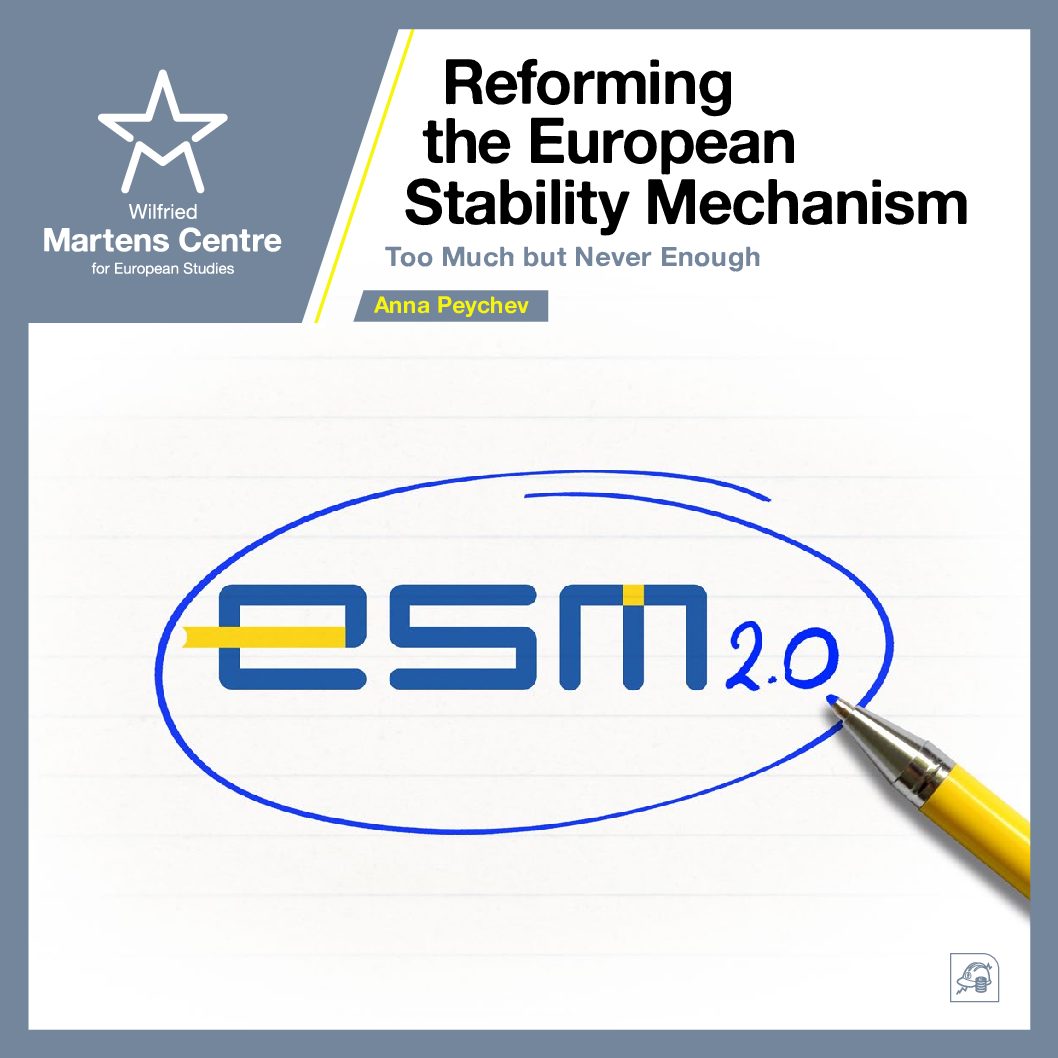
Reforming the European Stability Mechanism: Too Much but Never Enough

19 July 2021

On 27 January 2021 the member governments of the European Stability Mechanism (ESM) signed the Agreement Amending the ESM Treaty, instituting long-awaited reforms to the EU’s crisis management and financial-aid mechanism. The ESM was never perfect. Set up outside the EU treaty framework, it suffered from acute accountability and legitimacy issues and, being directly controlled by eurozone governments, its procedures were subject to cumbersome voting arrangements and conflicts of interest. Finally, with its inception in the throes of the eurozone crisis, it was committed to a single rigid approach based on conditionality.

The European Commission’s attempt to address these shortcomings in December 2017 was categorically rejected by the member states, who instead embarked on a separate reform initiative resulting in the current ESM Reform Treaty. This turn of events has been in part motivated by troubling levels of distrust between EU institutions and member states, and—as a result—between EU institutions and the ESM. The other driving force has been the political refusal to let go of the Maastricht promise of national fiscal sovereignty without shared liabilities. Thus, the ESM Reform Treaty is the culmination of a political campaign to redeem the economic compromise at the core of the Economic and Monetary Union and create an alternative arrangement for member states to avoid surrendering further competences to the EU.

This paper finds that the ESM Reform Treaty not only fails to address the outstanding issues in the original ESM framework, but exacerbates the status quo by further empowering the Mechanism outside the legal framework of the EU treaties. The ESM’s ‘peacetime powers’ represent a consequential novelty in this regard. These ‘powers’ are in fact the ESM’s own analytical capabilities, which have been extended beyond its financial-aid function and are now applicable within the bounds of the European Semester for economic governance. Perhaps worst of all, the ESM remains an extremely limited instrument, legally designed to imagine the single scenario of a sovereign debt crisis which requires disciplinary conditionality in exchange for financial aid. It would be careless to insist on this approach for resolving the multitude of difficulties which might befall the eurozone in the future.

Future reforms are not just advisable, they are a functional necessity. It will become increasingly difficult for the ESM to exercise its new powers or provide suitable crisis management without the efficiency and legitimacy which these adjustments could confer.

A compromise solution could see the ESM become its own independent technocratic institution, equally removed from the political influence of governments and the reach of the Commission. Introducing flexibility in its strict conditionality could be a matter of reinterpreting the meaning of ‘sound budgetary policy’ from the Court of Justice of the European Union’s ruling in Pringle. Lastly, in matters of justiciability and the protection of fundamental rights, nothing prevents ESM governments from committing the activities of the Mechanism to the European Charter on Fundamental Rights or the authority of the European courts, should they wish to do so.

Whatever decisions may be taken on the future of the ESM, they cannot ignore the unfolding of the EU’s fiscal response to the pandemic with Next Generation EU. Should the facility remain an exception, there would be even more pressure on the ESM to undergo another round of far-reaching reforms. However, should Next Generation EU prove a positive exercise, the EU should look to capitalise on the newfound trust by consolidating its economic and crisis governance capacities under a single flag—a certain blue one with 12 gold stars.


ENJOYING THIS CONTENT?

Stay up to date by joining our database !

Download the publication

See the publication in a flipbook

Reforming the European Stability Mechanism: Too Much but Never Enough

Research Papers

Anna Peychev

Edited by

Eoin Drea

Research Team

  • Crisis
  • Economy
  • Eurozone

Related publications

  • Sino-Russian Economic Relations: Dispelling the “No Limits” Partnership Myth

    Other

    Sino-Russian Economic Relations: Dispelling the “No Limits” Partnership Myth

  • Working Migrants Valued for Their Economic Contribution

    Other

    Working Migrants Valued for Their Economic Contribution

  • Strategic Policy Recommendations for the European People’s Party

    Other

    Strategic Policy Recommendations for the European People’s Party

  • Towards a New Order? The Economic Programmes of Right-Wing Populist Parties

    Research Papers

    Towards a New Order? The Economic Programmes of Right-Wing Populist Parties

  • From Taiwan to Malaysia: The Silicon Alley of the East

    Other

    From Taiwan to Malaysia: The Silicon Alley of the East

  • Breaking Free: Europe’s Path to Greater Financial Autonomy

    Policy Briefs

    Breaking Free: Europe’s Path to Greater Financial Autonomy

  • A Digital Euro: Balancing Innovation, Autonomy and Trust

    Policy Briefs

    A Digital Euro: Balancing Innovation, Autonomy and Trust

  • The 7Ds Extended

    The 7Ds

    The 7Ds Extended

You might also be interested by

  • The Real Cost of Russia’s War – Thinking Talks Ep 24 with Vladimir Milov

    Multimedia - Thinking Talks

    27 Nov 2025

  • Europe Watches as Trump Turns on the BBC – Bridge the Channel

    Bridge the Channel - Multimedia

    17 Nov 2025

  • Why Britain’s Migration Debate Matters to Brussels – Bridge The Channel

    Bridge the Channel

    20 Oct 2025

  • France and the Sick Men of Europe

    Blog

    10 Sep 2025

  • NATO’s Future: Demise, Reform, or Rebirth – Interview with Gerlinde Niehus – Thinking Talks

    Other News - Thinking Talks

    12 Aug 2025

  • Europe’s Competitiveness Compass is Pointing in the Right Direction – But it Overlooks the Workforce Crisis

    Blog

    04 Feb 2025

  • Friend or Foe? An Economic War With the U.S. Should Inspire Greater Canadian Autonomy

    Blog

    30 Jan 2025

  • It’s the Economy or Bust for Europe’s Centre Right in 2025

    Blog

    07 Jan 2025

  • On Revenants in Economic Policy: Taxing the Rich

    Blog

    31 Oct 2024

  • The Euro’s Weak Heart Threatens its Survival

    Blog

    17 Oct 2024

Related events

    • 12 - 14 September 2025

      Annual Seminar III Part : Can We Trust Democracy Again

      Vrnjačka Banja

      Common Projects

    • 14 November 2023

      Hostile Actors and Migration: Responding to Weaponised Population Flows

      Hostile Actors and Migration: Responding to Weaponised Population Flows

      Renaissance Hotel, Rue du Parnasse 19, 1050 Brussels

      In-House Events

Stay updated on Martens Centre Activities, Events and Publications

  • Navigate

    • Home
    • About
      • Who we are
      • Team
      • Bodies and Experts
      • Members
    • Publications
    • Events
    • News
    • Blog
    • Contact
  • More

    • A word from Wilfried Martens
    • European People’s Party
    • Join the team
    • Privacy Policy, Cookie policy & Legal
  • Contact us

    0032 (0)2 300 80 04
    20 Rue du Commerce
    1000 Brussels, Belgium

  • The activities of the Martens Centre receive financial support from the European Parliament. The European Parliament assumes no liability for the Martens Centre’s activities, the content of its publications, or the opinions expressed therein, nor for their subsequent use.

Copyright © 2025 | Martens Centre ALYS

Manage Cookie Consent
To provide the best experiences, we use technologies like cookies to store and/or access device information.
Functional Always active
The technical storage or access is strictly necessary for the legitimate purpose of enabling the use of a specific service explicitly requested by the subscriber or user, or for the sole purpose of carrying out the transmission of a communication over an electronic communications network.
Preferences
The technical storage or access is necessary for the legitimate purpose of storing preferences that are not requested by the subscriber or user.
Statistics
The technical storage or access that is used exclusively for statistical purposes. The technical storage or access that is used exclusively for anonymous statistical purposes. Without a subpoena, voluntary compliance on the part of your Internet Service Provider, or additional records from a third party, information stored or retrieved for this purpose alone cannot usually be used to identify you.
Marketing
The technical storage or access is required to create user profiles to send advertising, or to track the user on a website or across several websites for similar marketing purposes.
  • Manage options
  • Manage services
  • Manage {vendor_count} vendors
  • Read more about these purposes
View preferences
  • {title}
  • {title}
  • {title}
Go to mobile version