
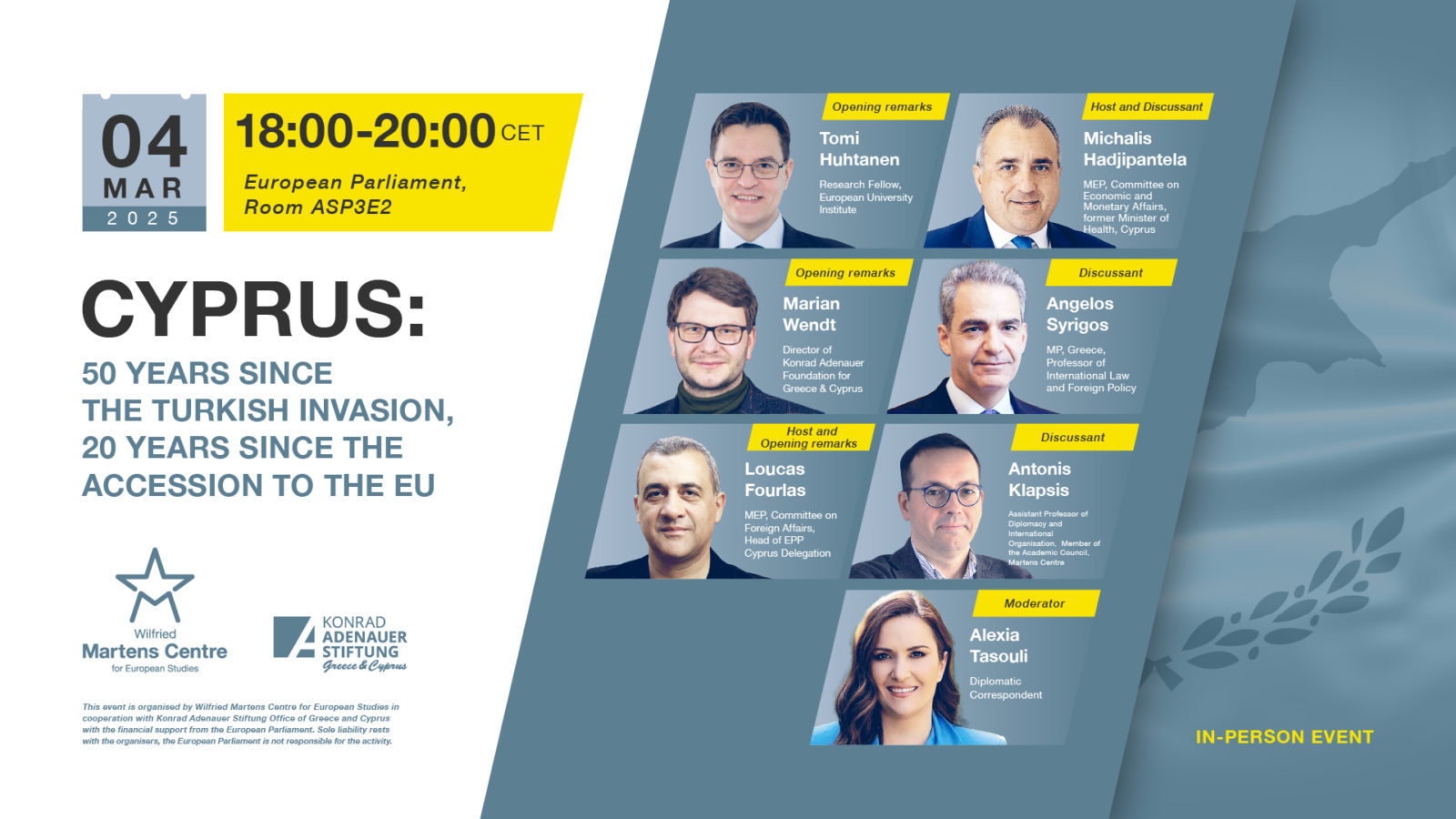
19 February 2025
This event will not be livestreamed.
INFORMATION INTEGRITY AND PRIVACY IN THE TIME OF DIGITIZATION AND ARTIFICIAL INTELLIGENCE
13 November 2024
Circolo Esperia’s conferences with the Wilfried Martens Centre for European studies promote a debate on key issues for the next European institutional cycle. In this meeting the issue of the digital revolution will be addressed, which is increasingly pervasive and brings great opportunities but also important risks, especially in the information and publishing sector, as demonstrated by the highly topical cases of increasingly frequent foreign interference in democratic processes.
The Power of Opacity: EU Responses to Weaponised Migration
25 October 2023

Orchestrating migration pressure has long been an instrument used by a variety of actors to create leverage, extract concessions, inflict damage on reputations or pursue other hostile intentions. The EU has faced several such attempts. These provide opportunities for comparison and analysis. The events organised by the Lukashenka regime in Belarus in 2021, by Türkiye in early 2020 and by Morocco in May 2021 are the most notable.
This policy brief argues that the EU has handled recent situations of migration coercion rather well and has the potential to handle them even better in the future. Recognising the reasons for this success and its limitations is necessary for defining a reliable toolbox, as the tools available currently are poorly understood and used inconsistently. This apparent inconsistency and fluidity of EU action is often subject to criticism in the media, a cause of exasperation for national and EU officials, and perceived as a serious deficiency to be remedied. However, the same policy and operational opacity has significant advantages: it makes the EU an unpredictable target for migration instrumentalisation, presenting adversaries with planning challenges.
Commenting on existing Commission proposals, the paper analyses both the added value they offer and their deficiencies and risks. Coherent EU-wide action that enhances the tools currently available would be preferable to individual national action. However, recent experience suggests that the continued unpredictability of EU responses, albeit based on an imperfect legislative status quo, is preferable to EU laws that might constrain the bloc’s room for manoeuvre. Also, decreasing the leverage available to hostile neighbours appears to require a controlled weakening of the link between a person and his or her rights.
A Blueprint For Accelerated Integration and Phasing-In
27 September 2023
The Women of Iran Deserve a Tough EU Line
15 September 2023
One year ago Jina Mahsa Amini dared to defy the Iranian regime by showing her hair in public. For this they murdered her. But she was not so easily disappeared; and her death was not mourned in silence. The world remains captivated and inspired by her courage.
The mass protests which followed Mahsa Amini’s murder showed not only the brutality but insecurity of a regime born in violence and marked, ever since, by an embrace of repression and regional unrest. A regime which uses its morality police to enforce political submission at home. Which supports Hezbollah, Hamas and other terrorist organizations abroad. Which seeks ‘death to Israel’, stakes its future on the Chinese Communist Party and aligns itself with Vladimir Putin, Kim Jon-Un, Bashar al-Assad and Nicolás Maduro. And which now sends its death machines to Russia for the indiscriminate killing of Ukrainians.
To combat the atrocities sponsored by this regime is why, last autumn, I and our KD party were the first in the Riksdag and in the European Parliament to push for calling a spade a spade and finally labelling the Iranian Revolutionary Guard Corps (IRGC) a terrorist organization. It’s why, in January, I championed the European Parliament’s resolution stating the clear fact that the terrible human rights abuses being carried out in Iran put at risk ongoing efforts to revive the nuclear agreement with the EU and EU partners — and why I then voted to suspend these talks. We can never accept the Iranian regime’s ability to wield a nuclear weapon; but nor has that regime earned the sanctions relief a nuclear deal would inevitably bring.
It is of course Iranians who have suffered most. Those in Iran who tell the truth about this, who push back, risk imprisonment and worse. We have seen recurring mass protests: against oppression, corruption and poor governance — and in response, recurring crackdowns. Last year, more than 500 protesters inspired by Mahsa Amini were killed. Just last week her uncle was inexplicably detained. The regime is frightened more people will take to the streets.
‘Women, Life, and Freedom’: this was the message inspired by Mahsa Amini. It is a universal message of dignity and opportunity, fullness and fairness — for women everywhere, and indeed for all people: since to silence and immure women is to stagnate, and ultimately die, as a society. And yet it is a message of hope Iran’s sclerotic leadership simply cannot abide, much less deliver.
Mahsa Amini’s example continues to challenge us, in Sweden, in Europe and beyond: to dare to tell the truth, stand up for what is right — and keep alive, always, our hope and drive for a better tomorrow. To fight injustice.
It’s why I nominated her — in our Swedish press and in the European People’s Party (EPP), the Christian Democratic group in the European Parliament — for the European Parliament’s 2023 Sakharov Prize, an honor given to an extraordinary defender of human dignity and human rights. It’s why I called for a debate in this past week’s plenary session, to commemorate Mahsa Amini at the one-year mark of her murder.
And it’s why, finally, I believe neither my country of Sweden nor the EU should engage the Iranian regime further on any outstanding issues, including revived nuclear talks — until all European citizens unjustly detained in Iran are returned safely home. Why should the brutal treatment and even execution of innocent victims be rewarded with face time or face-saving measures? This would betray the cause of Mahsa Amini and all those women and men still fighting for life and freedom.
Unfortunately, we have seen the Belgian government — and just this week, it seems, the US administration — making prisoner swaps. Of course I welcome, and celebrate together with their families, the safe return of all those held hostage in Iran. But will such ad hoc exchanges, sometimes bought at great cost, protect our citizens in the long run? Will they deter more malign actions on the part of the regime? Even more fundamentally, what has happened to the principle ‘no negotiations with terrorists’? I believe such deals are the wrong approach, for I fear they only encourage more hostage-taking down the road.
The EU should rather use all the tools we have to pressure the Iranian regime to change: by labelling the IRGC as terrorists, by raising the costs of human rights abuses with more EU sanctions — and by refusing to return to the table until all wrongly held EU citizens are freed. More than this, we in the European Union need a tough, coordinated, united stance vis-a-vis Iran together with the United States, United Kingdom and all our global partners. The bad behavior of this authoritarian regime must be checked.
The struggle for women, for life and for freedom continues in Iran and around the world. The spark of Mahsa Amini’s vision for a better future, fanned by her extraordinary courage, continues to burn bright. Let’s honor her memory, and the memory of all those who have suffered so much in taking up her cause. Let’s dare to follow her lead.
Is rural Ireland being forgotten through government policies?
24 May 2023
16:00 CET Welcome and Introduction (3 mins)
09 December 2022
16:03 CET Headlining Conversation – (15 mins with Q&A)
● Rep. Bill Keating, Chairman, House Subcommittee on Europe,
Eurasia, Energy and Environment
● Reena Ninan, Moderator
16:18 CET Panel Conversation – (35 mins with Q&A)
● Michael Abramowitz, President, Freedom House
● Timothy Garton Ash, Professor of European Studies, University of
Oxford
● Dr. Alina Polyakova, President and CEO, Center for European
Policy Analysis (CEPA)
● Reena Ninan, Moderator
16:53 CET Closing Keynote (5 minutes)
● Tomi Huhtanen, Executive Director, Wilfried Martens Centre for
European Studies
● Reena Nina, Moderator
16:58 CET Moderator Wrap-up
17:00 CET Program Ends
Rising tide of immigration to Europe pushing continent’s politics to the right, experts say
22 November 2022
Rising tide of immigration to Europe pushing continent’s politics to the right, experts say
22 November 2022
14 November 2022
Ireland’s future lies firmly in the EU but it can never be at the heart of Europe
15 September 2022
migration Update February 2022
04 April 2022
How have V4 countries responded to the Corona crisis?
05 November 2020