
Economic Growth is Europe’s Best Defence
14 January 2026

The EU enters 2026 facing – once again – its economic reality. Low growth, relatively good employment numbers, public debt inching upwards and an expanding list of new spending priorities. As for much of the last two decades, the bloc’s economic fundamentals remain stubbornly mediocre.
We all know the story of Europe’s current geopolitical crunch. The war in Ukraine has exposed Europe’s strategic dependencies, from energy to semiconductors. The real problem – currently overlooked – is that addressing these vulnerabilities requires sustained economic resources that current growth trajectories simply cannot provide.
Defence spending commitments ring hollow when public finances are already stretched and resistance to structural reform remains entrenched across member states. Even something as basic as Europe’s Banking Union (stalled since 2014) is still subject to rancour and division at member state level.
The uncomfortable truth Brussels refuses to acknowledge is that security and economic performance are inextricably linked. A Europe that cannot generate robust economic growth is a Europe that cannot fund its own defence, let alone project power beyond its borders.
Borrowing solves some immediate shortfalls, but it’s not – as history has shown us repeatedly – a long-term solution for financing the long-term expansion of a military base.
The political landscape makes matters worse. Populist movements across the continent have successfully weaponised economic stagnation, linking legitimate concerns about living standards to divisive cultural narratives. Mainstream parties have responded with a mix of solutions that have only partially addressed the underlying frustration driving voters toward the extremes.
The European middle classes, squeezed by housing costs, the rising cost of living, and economic insecurity, are losing faith in the European project’s ability to deliver prosperity. For the younger generations, the economic challenges increasingly feel insurmountable.
This is not an abstract problem for 2026 but a concrete political crisis that will play out in national elections and EU negotiations in the months and years ahead.
Consider the practical implications for key policy debates. The Green Deal imposes significant costs on European industry at precisely the moment when global competitors face no such constraints. Without a credible strategy to maintain industrial competitiveness during this transition, many European manufacturers will simply not survive.
Some of the EU’s regulatory initiatives – if not adjusted – risk handicapping European companies in sectors where scale and innovation matter decisively. Europe’s approach to economic policy too often seems designed for a world where European markets are large enough to dictate global terms. Unfortunately, this is a world which no longer exists.
What makes 2026 particularly consequential is the convergence of immediate pressures with longer-term structural challenges. An aging population means healthcare and pension costs are rising just as spending on defence must rise significantly. The artificial intelligence revolution threatens to displace millions of European workers while the continent struggles to produce global AI leaders.
Even in this post-internet AI age – Europe remains overly dependent on a traditional banking sector that remains fragmented and undercapitalised compared to American competitors.
These problems are well versed, and the solutions well known.
Usually this is the part of the article where the author extorts European leaders to embrace deepening the single market – particularly in services and the capital markets – as a way of heralding a new golden age of integration (and growth).
Alas, in an EU which can’t even agree to accept a trade deal with the Mercosur economies, further market integration will likely resemble a torrid process of half-measures. Think the acrimony of the global financial crisis from 2008, not the euro-enthusiasm of the late 1990s.
That’s because Europe first needs a cultural shift, even before political progress can take place.
Europe – western and southern continental Europe in particular – are trapped in a low-risk, low-reward strategic outlook. It’s a stability first model which was perfectly understandable in 1950, but wholly out of touch with 2026 realities. That’s why low growth is the new normal in Europe’s biggest economies and why public debt is rising to unsustainable proportions.
The role of the state has now become so large – and so indebted – that the allocation of risk and the financial burdens in society have become skewed. So, while the Italian government chokes under 3 trillion euros of debt (!), its households are among the richest in Europe with incredibly high savings levels and low debt. Simultaneously, its entire social security system is predicated on protecting the benefits of the older generations, while the young struggle and emigrate.
As a result, Europe is now full of very rich countries, with very poor, debt-filled governments.
French unwillingness to accept any notable pension reforms is a baguette-sized symbol of Europe’s fractured strategic thinking.
To generate real growth requires a fundamental reshaping of Europe’s social economic model. Meaningful economic expansion requires financial incentives at national level to better utilise existing cash reserves. Social security models need to reflect demographic realities and housing models overhauled to give younger people a chance to match (and exceed) the social standing and wealth of their parents.
Most fundamentally, European leaders need to explain honestly to voters that competitiveness requires difficult choices about labour markets, business regulation, and public spending priorities. 2026 will reveal whether Europe’s political class possesses the courage to make these choices or whether they will continue to substitute grand rhetoric for genuine reform.
Europe doesn’t need to chase the American model. It has more than enough wealth and capacity to develop its own distinctive approach. But without more risk – and more economic growth – Europe’s defence is doomed.
ENJOYING THIS CONTENT?

Related events
-
13 May 2026
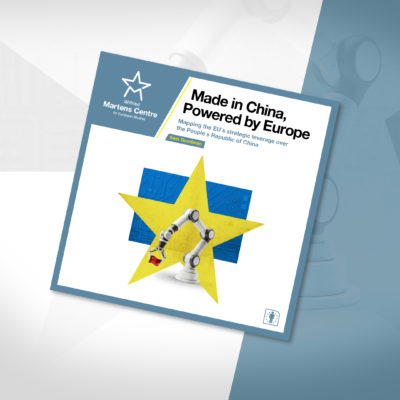
Made in China, Powered by Europe – Mapping the EU’s strategic leverage over the People’s Republic of China
TownHall Europe, Sq. de Meeûs 5, 1000 Bruxelles
In-House Events
-
09 November 2023

Publication Launch: Middle-Class Concerns and European Challenges
ACE Events, Avenue d’Auderghem 22,1040 Brussels
In-House Events
-
5 Messages That Stood out From the SOTEU
Blog
16 Sep 2026
-
A South Korean Warning on the Perils of the AI Economy
Blog
01 Sep 2026
-
Reset or Restart? Andy Burnham’s EU Challenge – Bridge the Channel
Bridge the Channel
27 Jul 2026
-
Decoding Sovereignty, Defence, Competitiveness: Democratic Resilience as the Key to Success
Blog
27 Jul 2026
-

“The Iran Knot”: How the War Exposed Italy’s Middle Power Dilemma
Blog
06 Jul 2026
-
Defence Readiness 2030 Requires More Than Higher Defence Spending
Blog
23 Jun 2026
-

Why Europe Struggles to Scale Startups – Thinking Talks Ep 25 with Peter Vesterbacka
Multimedia - Thinking Talks
26 May 2026
-
Simplifying Digital Rules & EU Tech Sovereignty – with Zach Meyers
Brussels Bytes - Podcasts
22 Apr 2026
-

Is UK’s cautious Iran’strategy paying off? I Bridge the Channel Ep.23
Bridge the Channel - Multimedia
30 Mar 2026
-

Is demographic decline really a crisis for Europe today? I Op-Ed Ep 11
Video Op-Eds
24 Mar 2026