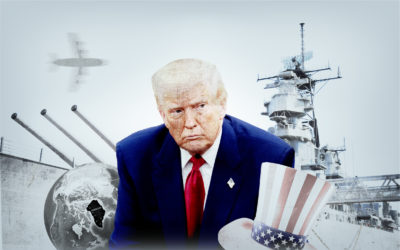
In 2016, before the US presidential election that brought Trump’s first term, Michael Anton, a conservative thinker and senior fellow at the Claremont Institute, published an article under the alias Publius Decius Mus, titled “Flight 93 Election.” Michael Anton’s article played a crucial role in convincing conservatives of the new American right, as well as the broader conservative establishment, to abandon their reservations and rally around Trump’s candidacy.
Anton’s argument to conservatives was that Trump may not have been the ideal candidate for the conservative counter-revolution, but he was aligned with their key priorities. He advocated economic nationalism, secure borders, and a foreign policy that prioritised America. Anton urged America’s serious conservative intellectuals to engage in political activism using an emotionally charged metaphor. He urged conservatives to charge the cockpit of the “American aircraft” together with Trump, just as the passengers of the ill-fated Flight 93 did on September 11, to take control and dismantle the ideological hegemony of the liberal left. “If he fails, they may not deserve the fate that will befall them, but they will suffer it regardless”. But if he succeeds, we will have a “second American Revolution that restores Constitutionalism, and limited government…”
The US National Security Strategy, published by the Trump administration in early December, exceeded the expectations of the new American right. It was a revolutionary document that completely overturned the post-war “rules-based” international order established by America, which was abided, in its basic tenets, by Democratic and Republican administrations until Trump. This text revived nationalism in the face of globalisation and economic mercantilism, declared war on immigration, and signalled America’s isolation in the Western hemisphere.
Maduro’s abduction and his transfer to American justice had all the ingredients of the new US Security Strategy. This was a unilateral action taken without convening the United Nations Security Council and without consulting either the Organization of American States or even America’s allies. It signaled the return to the realpolitik of the 19th century, gunboat diplomacy, spheres of influence, and a world where might is right. In domestic politics, the complete disregard for Congressional oversight of an act of war demonstrated the erosion of institutional checks and balances and the complete dominance of the executive branch. In other words, a drift to what Arthur Schlesinger identified as the excessive growth of presidential power beyond constitutional limits, the “Imperial Presidency”.
The dictator’s removal from power was not done to restore democracy. Trump’s statements showed that the form of the regime is not as important as its obedience to the Trump administration. Furthermore, Maduro’s removal was not only about combating drugs or grabbing Venezuela’s oil. It was a policy designed to assert American hegemony throughout the region. Hegemony in the Western Hemisphere, the Donroe Doctrine, as Trump himself called it, is the Monroe Doctrine with the addition of the “Roosevelt Corollary”, in an extreme Trumpian version.
The Monroe Doctrine of 1823 was a defensive policy by a newly formed state seeking to protect its interests in the wider region from the European colonial powers. In 1904, Theodore Roosevelt transformed the Monroe Doctrine into a doctrine of interventionism. Under the “Roosevelt Corollary”, the United States could intervene militarily in the Western Hemisphere to restore order and protect its interests. From a policy designed to exclude European powers from the Western Hemisphere, the Monroe Doctrine became the vehicle for American interventionism in Latin America. In its Trumpian version, the “Donroe Doctrine”, America proclaims that it will act unhinged in its hemisphere, from immigration and the war on drugs to the management of natural resources, regime change, renaming geographical sites, and even the annexation of territories.
America’s policies in its hemisphere revive imperialist and neo-colonial practices and divide the international chessboard into spheres of influence among the US, Russia, and China. If Venezuela, and tomorrow Greenland, are Trump’s Georgia and Ukraine, Taiwan could later be Xi’s Venezuela, and Moldova could be Putin’s Greenland.
The insistence of the Trump administration on its claims on Greenland, in particular, will test the already strained Euro-American relations and will undermine the solidarity of NATO.
European-American relations have already been tested on a number of issues from tariffs, to defense expenditures in NATO, the “burden sharing” issue, and support for Ukraine. Furthermore, the Trump administration has missed no opportunity to show its contempt for the European Union, whether in the form of Vance’s admonitions, the support of like-minded right-wing political forces in Europe, or the condescending view of Europe in the US National Security Strategy. Trump’s aversion to institutions, norms and procedures has amounted to a frontal attack on the very existence of the European Union. European leadership has responded by appeasing and cajoling Trump in an effort to salvage the Transatlantic Alliance. But sooner or later, it will have to face harsh realities. Europe was the cornerstone of the rules-based post-war international order, which the Trump administration has chosen to upend. The Trump administration is keen to a rapprochement with Russia even at the expense of its European Allies. Europe cannot depend on the American security guarantee anymore. We have returned to an international order of great power antagonism. That means that if a European version of De Gaulle’s “all-azimouth” strategy might be “a bridge too far”, certainly, European strategic autonomy has been long overdue.
In Europe, we need to realise that Trump’s foreign policy is revolutionary, and the new Security Strategy and the “Donroe doctrine” have unleashed forces that threaten to bring about a domino of uncontrollable geopolitical developments.
The National Security Strategy of the United States (NSS) released in December 2025 sent shock waves through Europe’s capitals. For many observers, the document marks the real “Zeitenwende” in transatlantic relations, shattering decades of an Atlantic community based on common values and interests. Most commentators have focused on the tectonic implications for the European security architecture, or the blatant interference in European domestic politics. Yet, the indirect ramifications for Europe’s broader global role, including in the Indo-Pacific, a global powerhouse, have received less attention. As shown by the brazen American intervention in Caracas, when President Maduro was seized by an American commando to be brought to the United States to stand trial, the United States’ new foreign policy doctrine is neither selective nor geographically bounded. The question for Europe is therefore, what does the NSS mean for Europe’s ties with China – and Taiwan?
Facing the Uncertainty
The first months of the Trump II administration saw a heated debate on whether the United States would remain committed to defending the integrity of Taiwan by continuing to contribute to its capacity to withstand the growing existential threat from the PRC. The NSS highlights Taiwan’s strategic importance as the cornerstone of US hegemony over the Western Pacific: “Taiwan provides direct access to the Second Island Chain and splits Northeast and Southeast Asia into two distinct theatres”.
The document emphasises that “deterring a conflict over Taiwan, ideally by preserving military overmatch, is a priority”. It also commits to “not support any unilateral change to the status quo in the Taiwan Strait”, a slightly different (and softer) language compared to previously used “oppose[s]” any such unilateral change.
The fact that while the NSS appears to deprioritise the Indo-Pacific while broadly maintaining continuity with past policy on Taiwan may be at once reassuring and worrying to both America’s closest allies in the region, as well as to Europe. One key question must therefore be asked: is this approach truly just a continuation of past administrations? What other, more fundamental changes in America’s foreign relations must Europe consider?
America First
The core message of the NSS is clear: “In everything we do, we are putting America First”. In other words, expect a US foreign policy that is no longer about seeking global leadership, or even promoting democratic values and a rule-based order. “The purpose of foreign policy is the protection of core national interests; that is the sole focus of this strategy.” Europe must adjust to this posture, not only in its transatlantic relationship, but concerning other major powers – and given its global weight and influence, China is the most relevant one.
The situation in Venezuela only reinforces this reality; the United States now firmly believes its best strategy is unilateralism and prioritising transactional bargaining with foreign actors, disregarding any commitment to established processes and multilateral cooperation and its associated legitimacy.
While the NSS is right about shared concerns of Western democracies about the lack of a level-playing field in trade relations with China, the US and Europe are unlikely to converge on how to manage China. Considering Trump’s clear penchant to a transactional and unilateral posture reiterated in the NSS, Europe must have its own China policy. This must be guided by its own interests. It must also rely on a robust, agile toolbox to boost the bloc’s competitiveness, and pursue coordination with like-minded partners that align with its interests and values.
For long, EU member states have failed to converge on a realistic and effective China policy to ensure the bloc has leverage, commensurate with its collective economic weight. The likelihood of alignment across the bloc remains low. The good news is that there is shared agreement that things must change. China’s continuous support to Russia, waging aggression in the heart of Europe, has accelerated efforts to reconsider the way the EU works. The bad news is that time is not on the EU’s side, and transatlantic relations are no longer what they used to be.
As the NSS suggests, for Washington under Trump, dialogue doesn’t matter. For Europe however, dialogue is paramount in everything it does. Europe must therefore choose a different approach, one that ensures maintaining open channels of communication with China. But at the same time Europe must be clear, firm, and strategic about what it wants from China whenever dialogue takes place.
Our belief in dialogue is also what sets us apart from Washington’s unpredictable and unreliable handling of international affairs. It is in Europe’s interest to position itself as a reliable partner to the Indo-Pacific – and Taiwan.
The European Union must adopt an assertive, clear, and consistent approach to Taiwan. Given its geostrategic importance to Europe’s security and prosperity, a consistent stance on Taiwan must be part of Europe’s strategic calculations going forward. As developments of recent years have made it clear, Taiwan is no longer merely an appendix to our China policy. It must remain anchored in an effective Indo-Pacific strategy of our own. To continue on this path, the EU must double down on its partnerships in the Indo-Pacific, including Japan, Korea, India, and countries in Southeast Asia (ASEAN).
At the same time, wherever possible and desirable, the EU must remain open to transatlantic coordination on China. The EU must invest in its ability to decide for itself, to be able to avoid pressure from Washington.
Conclusion
Ironically, the NSS claims that the US continues to be “the global partner of first choice”. Our take is: Europe is in a better position to be a trustworthy and reliable partner of choice for countries in the Indo-Pacific and beyond, including Taiwan, a democratic stronghold in the Western Pacific with a critical role in global supply chains. Additionally, we are now painfully aware that the US will not shy away from applying pressure where it sees fit in order to reach its goals. In other words, Europe has what it takes to become a relevant geopolitical actor amid global disruptions, but it must first learn to use its collective weight, rebuild its credibility vis-à-vis its partners, and deliver in line with partner countries’ needs.
Peter Hefele Zsuzsa Anna Ferenczy Asia Foreign Policy US
The riot at the U.S. Capitol was a stress test for our democracy. It is outrageous and inexcusable.
But, despite President Trump encouraging a frenzied crowd that went on to storm the U.S. Capitol, the very symbol of our democracy, our system of checks and balances held up remarkably well – and mostly because Republican leaders did the right thing when history called.
Granted, many Republicans can be faulted for trying to humour the President’s real and perceived grievances long after the states, the courts, and the Electoral College had their say, in the hopes of winning the special election for two Georgia Senate seats. Not only did that turn out to be morally suspect, but it didn’t work.
In the face of yesterday’s crisis, those same leaders stood strong and ensured that our Constitution and the process by which we transfer power to a new President prevailed.
Vice President Mike Pence’s loyalty to the President cannot be credibly challenged. Yet he repudiated the President’s demands to somehow overturn the certified electoral votes of some states. He went around the President to order the National Guard to respond to the Capitol Building. He performed his constitutionally mandated role in transferring power.
Senate Leader Mitch McConnell, even before the attack on the Capitol, gave a passionate plea to respect the results of the election. Although he had supported the President’s right to avail himself of legal remedies if fraud could be proven, he went on to say: “If this election were overturned by mere allegations from the losing side, our democracy would enter a death spiral. We’d never see the whole nation accept an election again. Every four years would be a scramble for power at any cost.”
McConnell also spoke of the necessary conditions for self-government. “Self-government, my colleagues, requires a shared commitment to the truth. And a shared respect for the ground rules of our system. We cannot keep drifting apart into two separate tribes with a separate set of facts and separate realities with nothing in common except our hostility towards each other and mistrust for the few national institutions that we all still share.”
Senator Mitt Romney is the only Republican alive who shares with Trump the emotions of losing a presidential election. The manner in which the two men behave could not be more different. “We gather today due to a selfish man’s injured pride and the outrage of his supporters whom he has deliberately misinformed for the past two months and stirred to action this very morning. What happened here today was an insurrection, incited by the President of the United States”, Sen. Romney said.
Liz Cheney, the current Chair of the House Republican Conference and daughter of former Vice President Dick Cheney, was unsparing in her criticism of the President. She wrote, “We just had a violent mob assault the U.S. Capitol … No question the President formed the mob, the President incited the mob, the President addressed the mob. He lit the flame.”
Former President George W. Bush, now the elder statesman of the Republican Party, called on citizens to put country above any one politician, party, or election. “I am appalled by the reckless behaviour of some political leaders since the election and by the lack of respect shown today for our institutions, our traditions, and our law enforcement…In the United States of America, it is the fundamental responsibility of every patriotic citizen to support the rule of law. To those who are disappointed in the results of the election: Our country is more important than the politics of the moment. Let the officials elected by the people fulfil their duties and represent our voices in peace and safety”, he wrote. He condemned the rioting, saying “This is how election results are disputed in a banana republic — not our democratic republic.”
These leaders spoke out and stood strong when the system of checks and balances depended on them to do so. This is the leadership that brought Congress late that night to conclude its constitutionally mandated duties and certify the election of Joe Biden as President.
There is much to discuss about this, and we will examine these things in great detail. But for now, my message to my European friends is that while this was a deeply troubling day, American democracy held firm, the checks and balances worked, and even Trump’s own party, including his Vice President, defied him to protect the Constitution and our democracy.
Even in the face of such an unprecedented event, the system of checks and balances held, and Congress carried out its constitutional duty. And that, actually, is what makes America great.
To provide the best experiences, we use technologies like cookies to store and/or access device information.
Functional
Always active
The technical storage or access is strictly necessary for the legitimate purpose of enabling the use of a specific service explicitly requested by the subscriber or user, or for the sole purpose of carrying out the transmission of a communication over an electronic communications network.
Preferences
The technical storage or access is necessary for the legitimate purpose of storing preferences that are not requested by the subscriber or user.
Statistics
The technical storage or access that is used exclusively for statistical purposes.The technical storage or access that is used exclusively for anonymous statistical purposes. Without a subpoena, voluntary compliance on the part of your Internet Service Provider, or additional records from a third party, information stored or retrieved for this purpose alone cannot usually be used to identify you.
Marketing
The technical storage or access is required to create user profiles to send advertising, or to track the user on a website or across several websites for similar marketing purposes.


 Loading...