Martens Centre
  • Home
  • About
    • Who we are
    • Team
    • Bodies and Experts
    • Members
  • Publications
  • Events
  • News
  • Blog
  • Contact
back

Publications

  • Home
  • About
    • Who we are
    • Team
    • Bodies and Experts
    • Members
  • Publications
  • Events
  • News
  • Blog
  • Contact
Share this...
  • Facebook
  • Twitter
  • Linkedin
  • Email

 The Polish Case of Deregulation: Bottom-up Action as a First Step for Simplification

30 November 2025

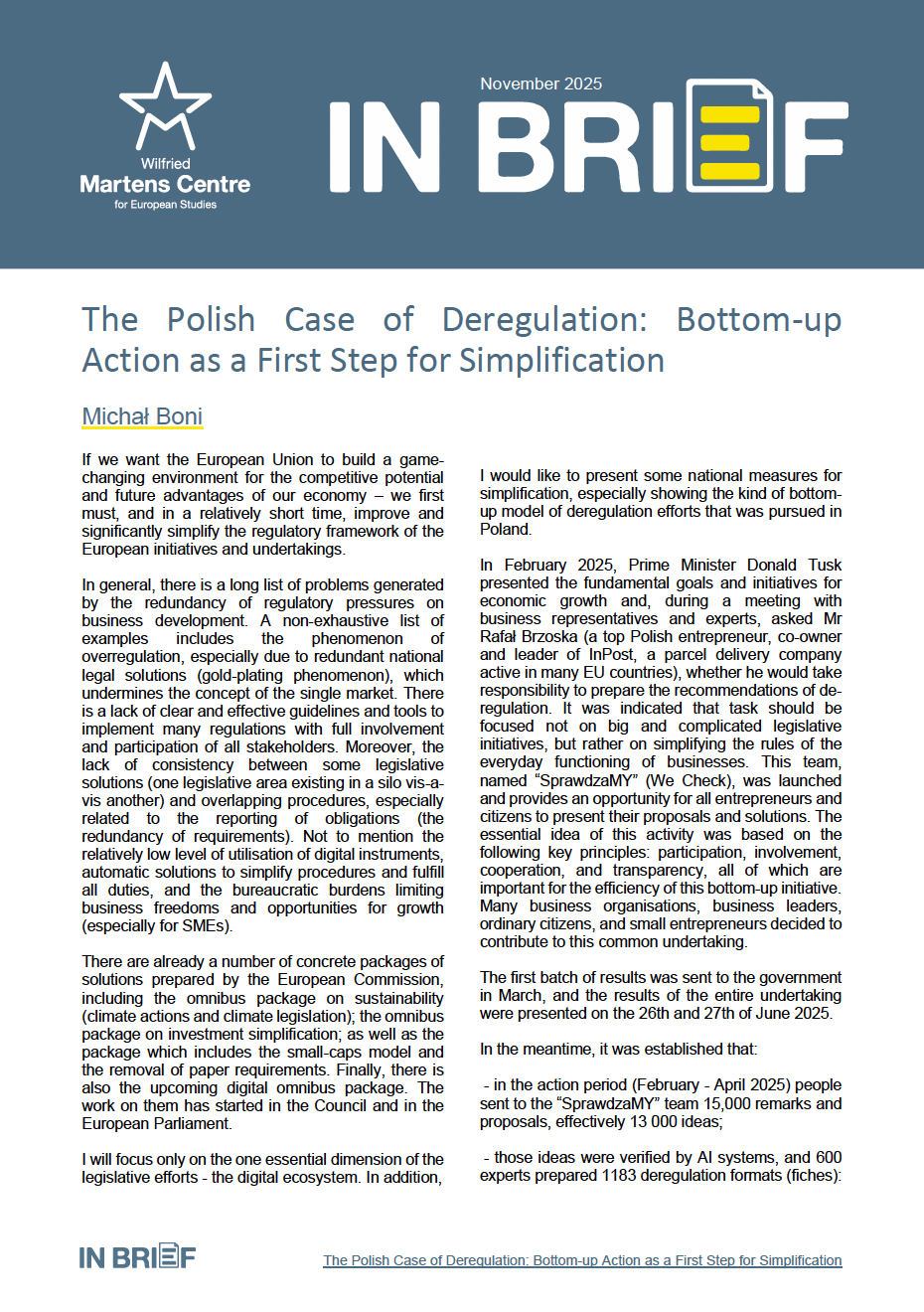
If we want the European Union to build a gamechanging environment for the competitive potential and future advantages of our economy – we first must, and in a relatively short time, improve and significantly simplify the regulatory framework of the European initiatives and undertakings.

In general, there is a long list of problems generated by the redundancy of regulatory pressures on business development. A non-exhaustive list of examples includes the phenomenon of overregulation, especially due to redundant national legal solutions (gold-plating phenomenon), which undermines the concept of the single market. There is a lack of clear and effective guidelines and tools to implement many regulations with full involvement and participation of all stakeholders. Moreover, the lack of consistency between some legislative solutions (one legislative area existing in a silo vis-avis another) and overlapping procedures, especially related to the reporting of obligations (the redundancy of requirements). Not to mention the relatively low level of utilisation of digital instruments, automatic solutions to simplify procedures and fulfill all duties, and the bureaucratic burdens limiting business freedoms and opportunities for growth (especially for SMEs).

There are already a number of concrete packages of solutions prepared by the European Commission, including the omnibus package on sustainability (climate actions and climate legislation); the omnibus package on investment simplification; as well as the package which includes the small-caps model and the removal of paper requirements. Finally, there is also the upcoming digital omnibus package. The work on them has started in the Council and in the European Parliament.

This paper will focus only on the one essential dimension of the legislative efforts – the digital ecosystem. In addition, this paper seeks to present some national measures for simplification, especially showing the kind of bottom-up model of deregulation efforts that was pursued in Poland.

ENJOYING THIS CONTENT?

Stay up to date by joining our database !

Download the publication

See the publication in a flipbook

 The Polish Case of Deregulation: Bottom-up Action as a First Step for Simplification

IN BRIEF

Michał Boni

  • Regulation

Related publications

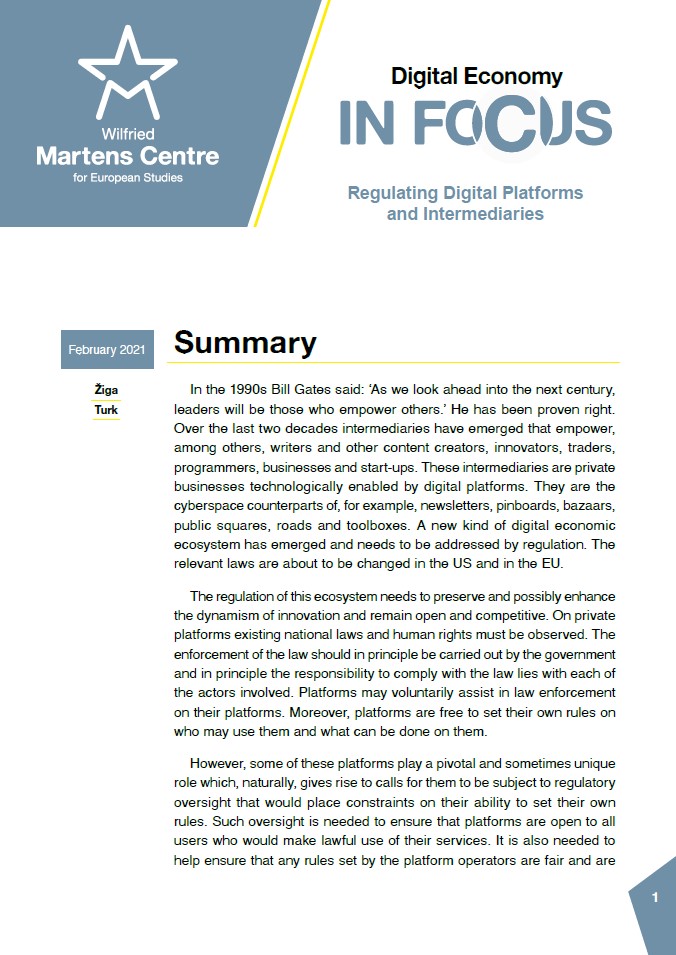
  • Digital Economy: Regulating Digital Platforms and Intermediaries

    IN FOCUS

    Digital Economy: Regulating Digital Platforms and Intermediaries

You might also be interested by

  • EU Red Tape: An Endless Struggle or a Solvable Problem?

    Blog

    06 Feb 2025

  • Avoiding a Net-Zero Sum Game in Transatlantic Relations

    Blog

    05 Apr 2023

  • The EU’s Failure to Protect Our Online Privacy and Data Rights, with Dr. Johnny Ryan

    Brussels Bytes

    21 Oct 2021

  • EIF21 Panel 3 – Europe’s Digital Decade: Regulate and Chill?

    Live-streams - Multimedia

    30 Jun 2021

  • A Transatlantic Agenda for Digital Transformation

    Blog

    13 Nov 2020

Stay updated on Martens Centre Activities, Events and Publications

  • Navigate

    • Home
    • About
      • Who we are
      • Team
      • Bodies and Experts
      • Members
    • Publications
    • Events
    • News
    • Blog
    • Contact
  • More

    • A word from Wilfried Martens
    • European People’s Party
    • Join the team
    • Privacy Policy, Cookie policy & Legal
  • Contact us

    0032 (0)2 300 80 04
    20 Rue du Commerce
    1000 Brussels, Belgium

  • The activities of the Martens Centre receive financial support from the European Parliament. The European Parliament assumes no liability for the Martens Centre’s activities, the content of its publications, or the opinions expressed therein, nor for their subsequent use.

Copyright © 2026 | Martens Centre ALYS

Manage Cookie Consent
To provide the best experiences, we use technologies like cookies to store and/or access device information.
Functional Always active
The technical storage or access is strictly necessary for the legitimate purpose of enabling the use of a specific service explicitly requested by the subscriber or user, or for the sole purpose of carrying out the transmission of a communication over an electronic communications network.
Preferences
The technical storage or access is necessary for the legitimate purpose of storing preferences that are not requested by the subscriber or user.
Statistics
The technical storage or access that is used exclusively for statistical purposes. The technical storage or access that is used exclusively for anonymous statistical purposes. Without a subpoena, voluntary compliance on the part of your Internet Service Provider, or additional records from a third party, information stored or retrieved for this purpose alone cannot usually be used to identify you.
Marketing
The technical storage or access is required to create user profiles to send advertising, or to track the user on a website or across several websites for similar marketing purposes.
  • Manage options
  • Manage services
  • Manage {vendor_count} vendors
  • Read more about these purposes
View preferences
  • {title}
  • {title}
  • {title}
Go to mobile version