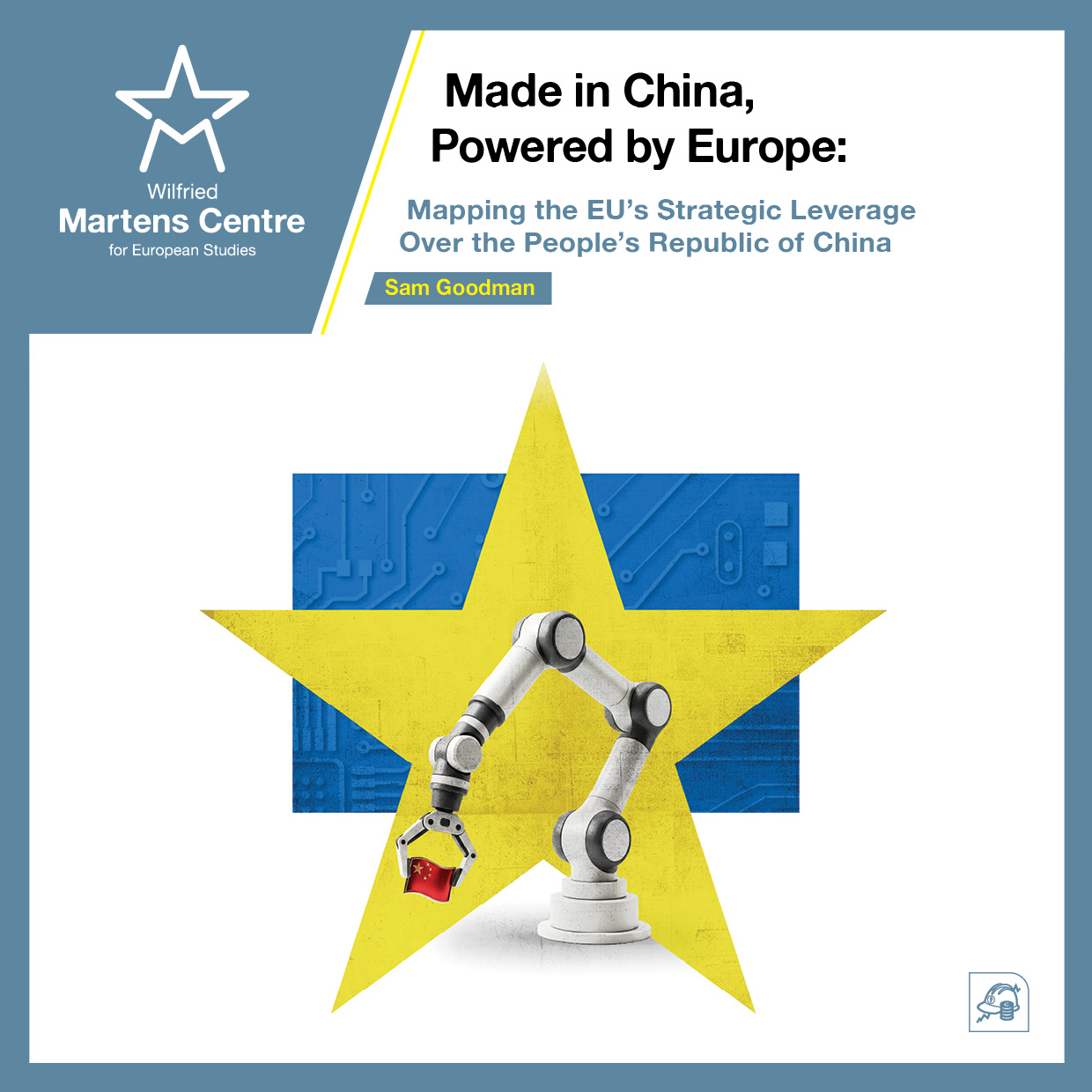

Made in China, Powered by Europe: Mapping the EU’s Strategic Leverage Over the People’s Republic of China
06 May 2026
This research paper offers an overview of ongoing trade tensions between the EU and the People’s Republic of China (PRC) regarding the latter’s unfair competition practices and large trade surplus. It analyses the way the PRC utilises strategic leverage against the EU and other trading partners, and assesses the sectors of China’s economy in which there is still a level of strategic dependence on European businesses. Finally, the paper provides policy recommendations on how the EU can utilise this strategic leverage and strengthen its approach to economic security.
An increasingly emboldened PRC, which sees itself as a peer in economic power to the US, has become a master at utilising strategic leverage to achieve its policy aims and ideological goals. It does so using tools ranging from making formal dialogues conditional, using import bans to exert pressure and utilising foreign investment as strategic leverage, to the recent weaponisation of rare earth element export-control licences.
Despite narratives from the PRC to the contrary, the EU has strategic leverage in areas in which the PRC has dependencies: that is, in a number of narrow sectors which China believes to be integral to its future industry, including semiconductor chips, civil aviation, pharmaceuticals and biotechnology, and robotics. However, these dependencies weaken every month and will likely be non-existent within the next decade. The EU, therefore, has the choice of using or losing its strategic leverage over Beijing.
ENJOYING THIS CONTENT?
Stay up to date by joining our database !