Martens Centre
  • Home
  • About
    • Who we are
    • Team
    • Bodies and Experts
    • Members
  • Publications
  • Events
  • News
  • Blog
  • Contact
back

Publications

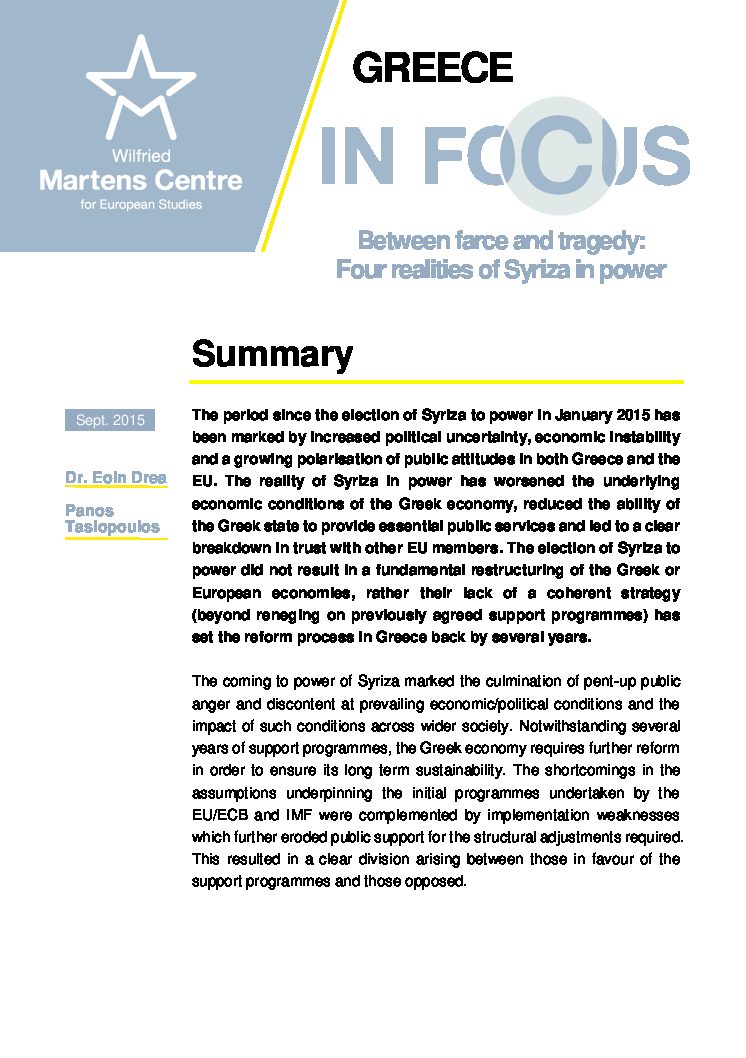
Greece – Between farce and tragedy: Four realities of Syriza in power

16 September 2015

The period since the election of Syriza to power in January 2015 has been marked by increased political uncertainty, economic instability and a growing polarisation of public attitudes in both Greece and the EU. The reality of Syriza in power has worsened the underlying economic conditions of the Greek economy, reduced the ability of the Greek state to provide essential public services and led to a clear breakdown in trust with other EU members. The election of Syriza to power did not result in a fundamental restructuring of the Greek or European economies, rather their lack of a coherent strategy (beyond reneging on previously agreed support programmes) has set the reform process in Greece back by several years.

The coming to power of Syriza marked the culmination of pent-up public anger and discontent at prevailing economic/political conditions and the impact of such conditions across wider society. Notwithstanding several years of support programmes, the Greek economy requires further reform in order to ensure its long term sustainability. The shortcomings in the assumptions underpinning the initial programmes undertaken by the EU/ECB and IMF were complemented by implementation weaknesses which further eroded public support for the structural adjustments required. This resulted in a clear division arising between those in favour of the support programmes and those opposed. 

The level of financial adjustment required in Greece – over 20% of GDP – imposed significant socio-economic challenges. In the public mind, ownership of the reform process then passed from national bodies to imposed, supra-national institutions, thus increasing resistance at both public and political levels in Greece. Resistance fuelled by populist political parties seeking short-term political gain.

Syriza in power has sought to deliberately widen the gulf between those who acknowledge the long term importance of the many difficult structural reforms required, and those who seek to blame “austerity” for Greece’s current woes. In reality, the experience of Syriza in power has highlighted its complete lack of a defensible economic and political strategy which safeguards Greece’s position in the EU, protects the well-being of its citizens and acknowledges the current standing of the Greek economy.

IN FOCUS is a new series of commentaries in which the Martens Centre looks closely at current policy topics, dissects the available evidence and challenges prevailing opinions.

ENJOYING THIS CONTENT

Stay up to date by joining our database !

Download the publication

IN FOCUS

Eoin Drea

Panos Tasiopoulos

  • Crisis
  • Economy
  • EU Member States
  • Eurozone
  • Populism

Related publications

Other

Other

Other

Other

Research Papers

Other

Other

Policy Briefs

You might also be interested by

The Real Cost of Russia’s War – Thinking Talks Ep 24 with Vladimir Milov

Multimedia - Thinking Talks

27 Nov 2025

EU Enlargement 2025: Ambition vs Reality – Thinking Talks Ep 23 with Skander Nasra

Multimedia - Thinking Talks

20 Nov 2025

Europe Watches as Trump Turns on the BBC – Bridge the Channel

Bridge the Channel - Multimedia

17 Nov 2025

Why Britain’s Migration Debate Matters to Brussels – Bridge The Channel

Bridge the Channel

20 Oct 2025

Make the West Great Again – Interview with Angelos Chryssogelos

Podcasts - The European View Podcast

20 Oct 2025

A European way of war – Interview with Garvan Walshe

Podcasts - The European View Podcast

03 Oct 2025

UK instability spells potential trouble for the EU

Bridge the Channel

16 Sep 2025

France and the Sick Men of Europe

Blog

10 Sep 2025

NATO’s Future: Demise, Reform, or Rebirth – Interview with Gerlinde Niehus – Thinking Talks

Other News - Thinking Talks

12 Aug 2025

Related events

12 - 14 September 2025

Annual Seminar III Part : Can We Trust Democracy Again

Vrnjačka Banja

Common Projects

16 July 2025

The Western Balkans: Integration through standards or accession for stability

Tirana, Albania

Common Projects

Stay updated on Martens Centre Activities, Events and Publications

Copyright © 2025 | Martens Centre ALYS

Manage Cookie Consent
To provide the best experiences, we use technologies like cookies to store and/or access device information.
Functional Always active
The technical storage or access is strictly necessary for the legitimate purpose of enabling the use of a specific service explicitly requested by the subscriber or user, or for the sole purpose of carrying out the transmission of a communication over an electronic communications network.
Preferences
The technical storage or access is necessary for the legitimate purpose of storing preferences that are not requested by the subscriber or user.
Statistics
The technical storage or access that is used exclusively for statistical purposes. The technical storage or access that is used exclusively for anonymous statistical purposes. Without a subpoena, voluntary compliance on the part of your Internet Service Provider, or additional records from a third party, information stored or retrieved for this purpose alone cannot usually be used to identify you.
Marketing
The technical storage or access is required to create user profiles to send advertising, or to track the user on a website or across several websites for similar marketing purposes.
  • Manage options
  • Manage services
  • Manage {vendor_count} vendors
  • Read more about these purposes
View preferences
  • {title}
  • {title}
  • {title}
Exit mobile version
To provide the best experiences, we use technologies like cookies to store and/or access device information.