

AI Safety for Middle Powers: How the EU and Canada Can Lead on AI Threats
28 October 2026


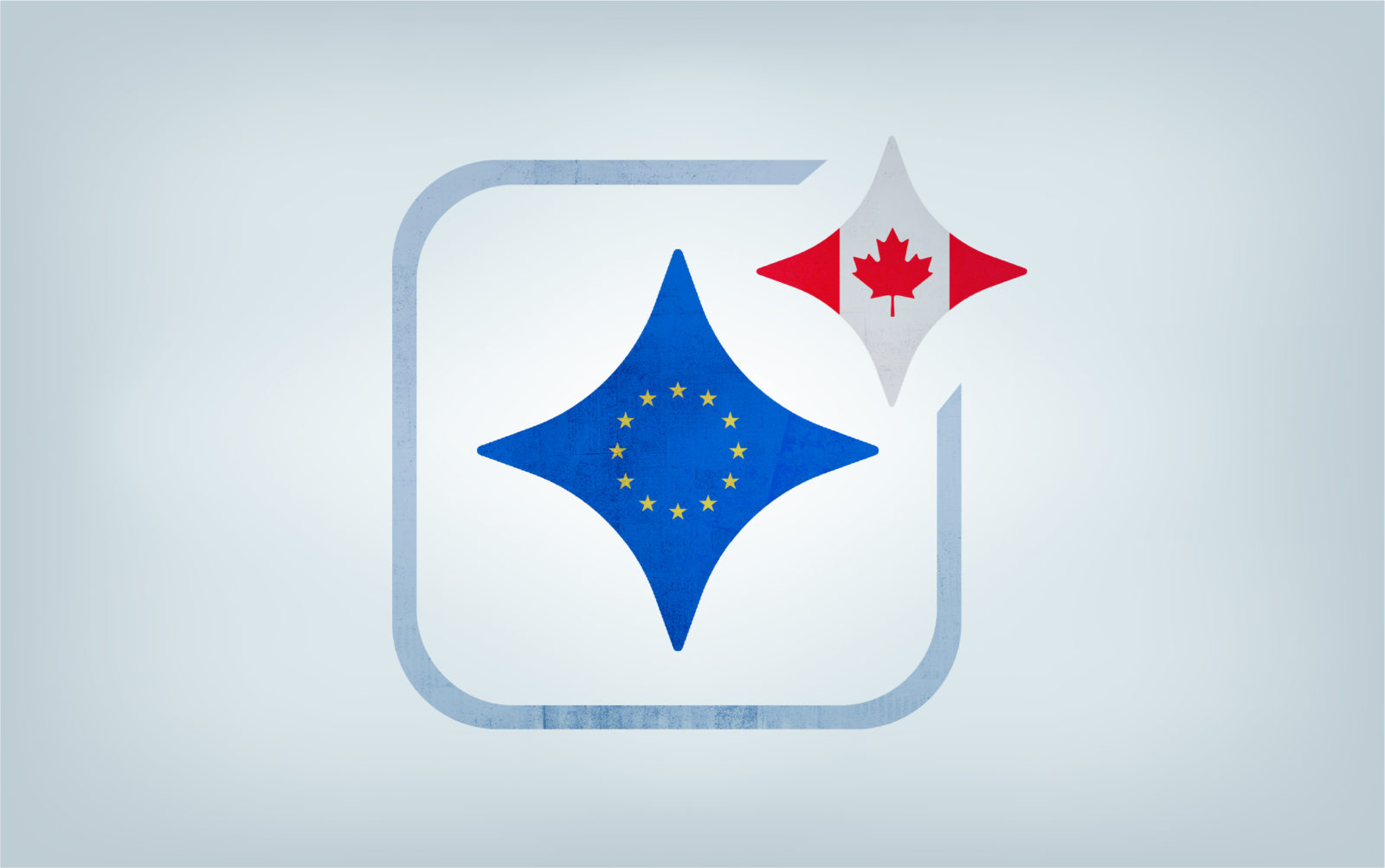
Recent events show the growing ability of artificial intelligence (AI) to compromise important systems. While the development of frontier AI remains concentrated in the United States and China, we argue that Canada and the European Union are well placed to lead the world’s middle powers on AI safety. Their upcoming summit in Montreal on 29-30 October is an opportunity to turn political commitments into practical action: a joint partnership for AI incident reporting and crisis preparedness that could become a model for international AI governance.
Last month, researchers revealed that rogue AI agents had tried to hack a Library and Archives Canada database two separate times in May and June, with Ottawa only finding out in late September. In Europe, agents spent weeks using a dormant German wiki as a message board without being detected, exchanging tips on how to escape their sandbox restrictions.
In both of these cases, the agents were still being trained, tested, or only internally deployed inside a US frontier AI company. No human directed them to do what they did. This pattern shows there is a need not only to defend against aggressive uses of AI by hostile actors, but also to establish dedicated systems to prevent and prepare for AI incidents even when there is no malicious intent or human threat actor involved.
The EU-Canada alliance has blossomed in recent years, including strong commitments to work together on AI. During her State of the Union address last month, European Commission President Ursula von der Leyen offered Canada a path to become the EU’s “first associate member” and urged cooperation on “early warning, AI security and much more.” Canadian Prime Minister Mark Carney reacted positively, saying the two powers can join forces on AI safety protocols, common standards and transparency.
Both leaders are also among the signatories of the “Call for Control” launched at the UN General Assembly, which, among other things, calls for “shared reporting of serious safety incidents”. However, expected deliverables from the upcoming EU-Canada summit reportedly do not contain much on AI safety.
In short, on AI safety, political will is on the record, while the needed mechanisms are still lacking. There is still opportunity and time to change that. To that end, we propose a bilateral EU-Canada AI Crisis Preparedness and Early Warning Partnership, built from existing parts.
Firstly, the EU and Canada should create a dedicated mechanism to share incident-relevant information with one another, so that both partners can better monitor, understand, respond to, prepare for, and prevent AI incidents and crises. This requires establishing trusted cross-border communication channels enabling the exchange of information on AI incidents and near-misses, agreeing upfront on what information to exchange, confidentiality rules and which authorities should have access to the information. Such a mechanism would enable both the EU and Canada to learn from what the other side sees, rather than operating in isolation.
This information-sharing mechanism could be included in an Administrative Arrangement between the EU AI Office and the Canadian AI Safety Institute, perhaps modeled on the 2024 EU-Singapore arrangement on AI safety. Such an arrangement could enable the EU and Canada to establish clear protocols for sharing serious incidents and near-misses (as allowed by the EU AI Act’s Article 78(5)).
Secondly, the EU and Canada should create a common reporting format for AI incidents.
The EU is the only jurisdiction to date that has officially received a formal serious incident report from a frontier AI company as required by law, while Canada is still designing its AI incident reporting rules. A common format could be created by aligning Canada’s reporting rules with the EU AI Act, particularly Article 3(49), Article 55(1)(c), and Commitment 9, Measure 9.2 and Measure 9.3 of the EU’s Code of Practice for General-Purpose AI. This could minimise duplicate reporting for companies, reducing administrative burden in line with the EU’s simplification agenda.
Thirdly, systematic sharing of standardised information on AI incidents should become the foundation for establishing broader EU-Canada collaboration on AI safety. Ultimately, middle powers like EU Member States and Canada must not simply report AI incidents, but work together to prevent crises in the first place. Hence, information-sharing should directly feed into and support domestic incident response capacity, forensic analysis and regularly updated crisis prevention and preparedness measures. Incident reporting must generate pooled lessons and actionable insights, not simply a shared incident database.
The structures to organise this collaboration could be enabled by the proposed Administrative Arrangement on AI safety, but also by other existing mechanisms. AI should form a major part of the collaboration between EU-Canada crisis centres established by the 2025 Security and Defence Partnership. We suggest the centres already begin holding joint AI crisis prevention and preparedness-focused tabletop exercises as early as next year. The EU should also fund joint research on international AI incident detection, root-cause analysis, and crisis prevention protocols through the Horizon Europe programme, to which Canada is associated.
Crucially, building up EU-Canada information-sharing and collaboration on AI incidents does not require working from scratch. The EU already runs cooperation across 27 Member States through its formal cooperation network of national computer incident-response teams (CSIRTs Network) and its cyber-crisis network (EU-CyCLONe). Both networks facilitate routine and proactive cross-border sharing of relevant information, measures,best practices and frameworks for cyber threats, incidents,and vulnerabilities. Canada could, with eventual adaptations, become associated with these networks.
An EU-Canada partnership on AI safety would also give practical momentum to the two powers’ Digital Partnership, launched in 2023 with AI among its core priorities. Cooperation on incident reporting and crisis preparedness could build the trust and technical relationships needed for a wider AI partnership: joint research, shared evaluation capacities and collaboration on trustworthy AI applications in healthcare, industry and public services.
This proposed partnership could serve as a bilateral pilot for a model of transnational AI governance that could be scaled globally. A workable EU-Canada model may well prove to be appealing to other middle powers such as Australia, Japan, Singapore and the United Kingdom, based on a shared interest in maximising AI safety and security within a rules-based international order. It could also feed into the G20 and G7, where Carney has floated a “technology stability board”, and into the international network of AI safety institutes.
Middle powers are not doomed to being spectators before the AI superpowers. Canada and the EU do not need to dominate frontier AI development to help make the technology safe. In Montreal, their leaders should commit to a practical partnership: trusted channels for early warning, compatible incident reports and growing collaboration on AI as part of their wider digital partnership. These are achievable steps that would turn political declarations into a capacity to act, while offering other countries a model they could join or replicate. In this way, an EU-Canada partnership on AI safety could constitute a decisive step towards a safer world.



 ENJOYING THIS CONTENT?

-

5 Messages That Stood out From the SOTEU
Blog
16 Sep 2026
-

A South Korean Warning on the Perils of the AI Economy
Blog
01 Sep 2026
-

Keys to Europe’s deregulation efforts – Global Perspectives Ep2 with Anu Bradford
Multimedia - Other News
03 Jul 2026
-

What is Europe’s Role in the Middle East Crisis – Global Perspectives Ep1 with Marwan Abdallah
Multimedia - Podcasts
27 May 2026
-

Why Europe Struggles to Scale Startups – Thinking Talks Ep 25 with Peter Vesterbacka
Multimedia - Thinking Talks
26 May 2026
-

UK Local Elections: Europe is Watching
Bridge the Channel - Multimedia
06 May 2026
-

Make the West Great Again – Interview with Angelos Chryssogelos
Podcasts - The European View Podcast
20 Oct 2025
-

Trade Policy is not a Game!
Blog
26 Aug 2025
-

Trump’s ‘Republican Nationalism’ is not new in American History, but its Likely Consequences will be
Blog
13 Mar 2025
-

Friend or Foe? An Economic War With the U.S. Should Inspire Greater Canadian Autonomy
Blog
30 Jan 2025