
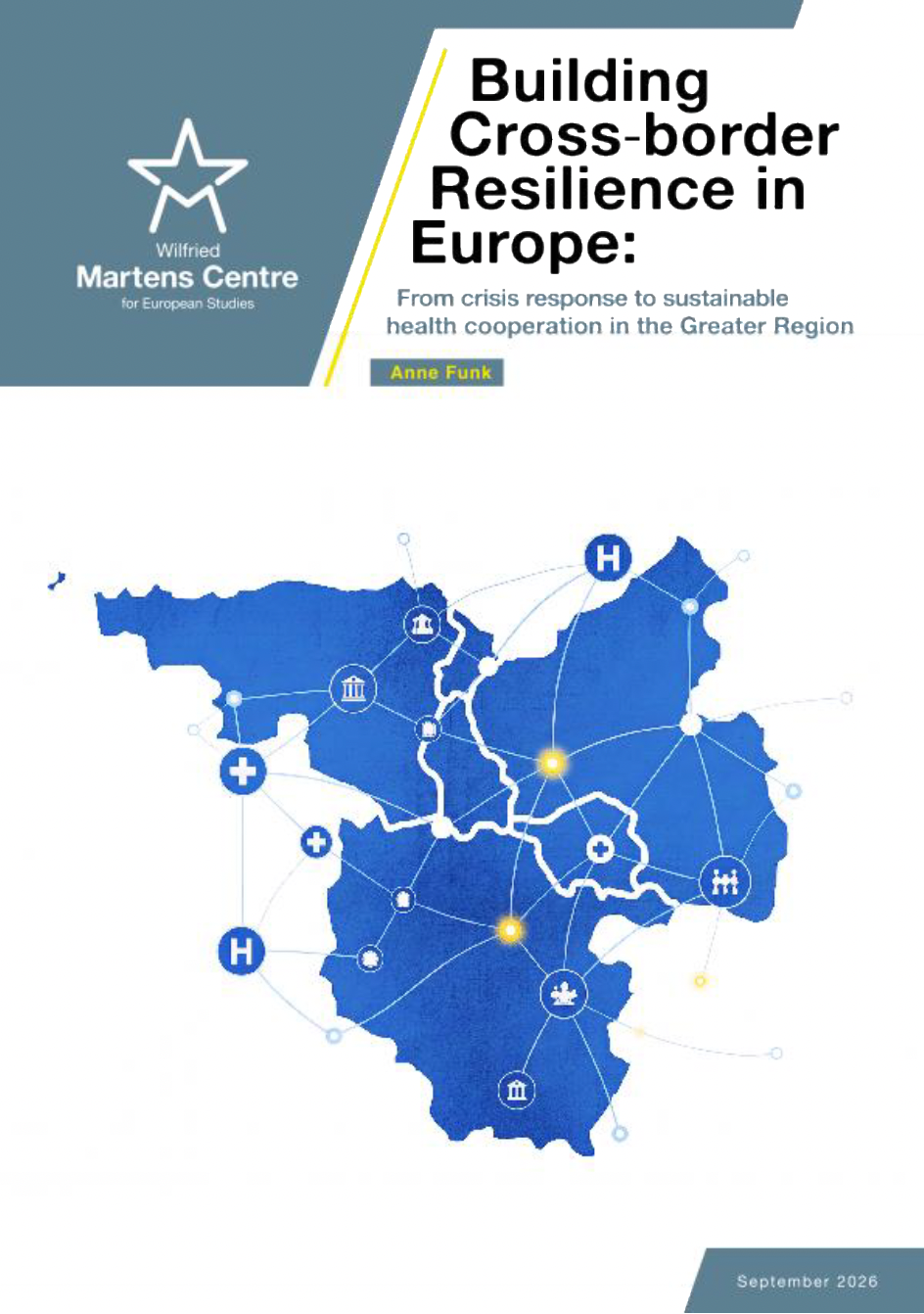

Building Cross-Border Resilience in Europe: From crisis response to sustainable health cooperation in the Greater Region

On the morning of 16 March 2020, the cross-border region between France, Germany, Belgium and Luxembourg awoke to a reality that had seemed unthinkable only days before. Roads that had served as daily arteries for more than 250 000 cross-border commuters were suddenly blocked by police cars. Nurses queued at dawn to reach hospitals across the border. Families waved across metal barriers. The invisible lines of Europe — long softened by decades of integration — re-emerged abruptly, sharply and painfully. What had been a fluid, interconnected space became a patchwork of national jurisdictions overnight. The Greater Region, one of Europe’s most integrated socio-economic areas, was thrust into a stress test of historic proportions.

[…] This paper builds explicitly on the work of Nora Crossey, Julia Dittel and Florian Weber, whose research between 2021 and 2024 provides one of the most comprehensive analytical frameworks for understanding cross-border governance in the Greater Region. Weber argues that the region constitutes a functional space without territorial governance — a socio-economic system that operates across borders, but whose governance, border regimes, and cross-border interdependencies form the conceptual backbone of this paper. They help explain why the Greater Region was simultaneously resilient and fragile during the pandemic: resilient because of dense social and institutional networks; fragile because these networks lacked formalised governance structures to manage systemic shocks.