
From Partner to Problem – How Trump’s Foreign Policy is Reshaping the World Order
22 January 2026

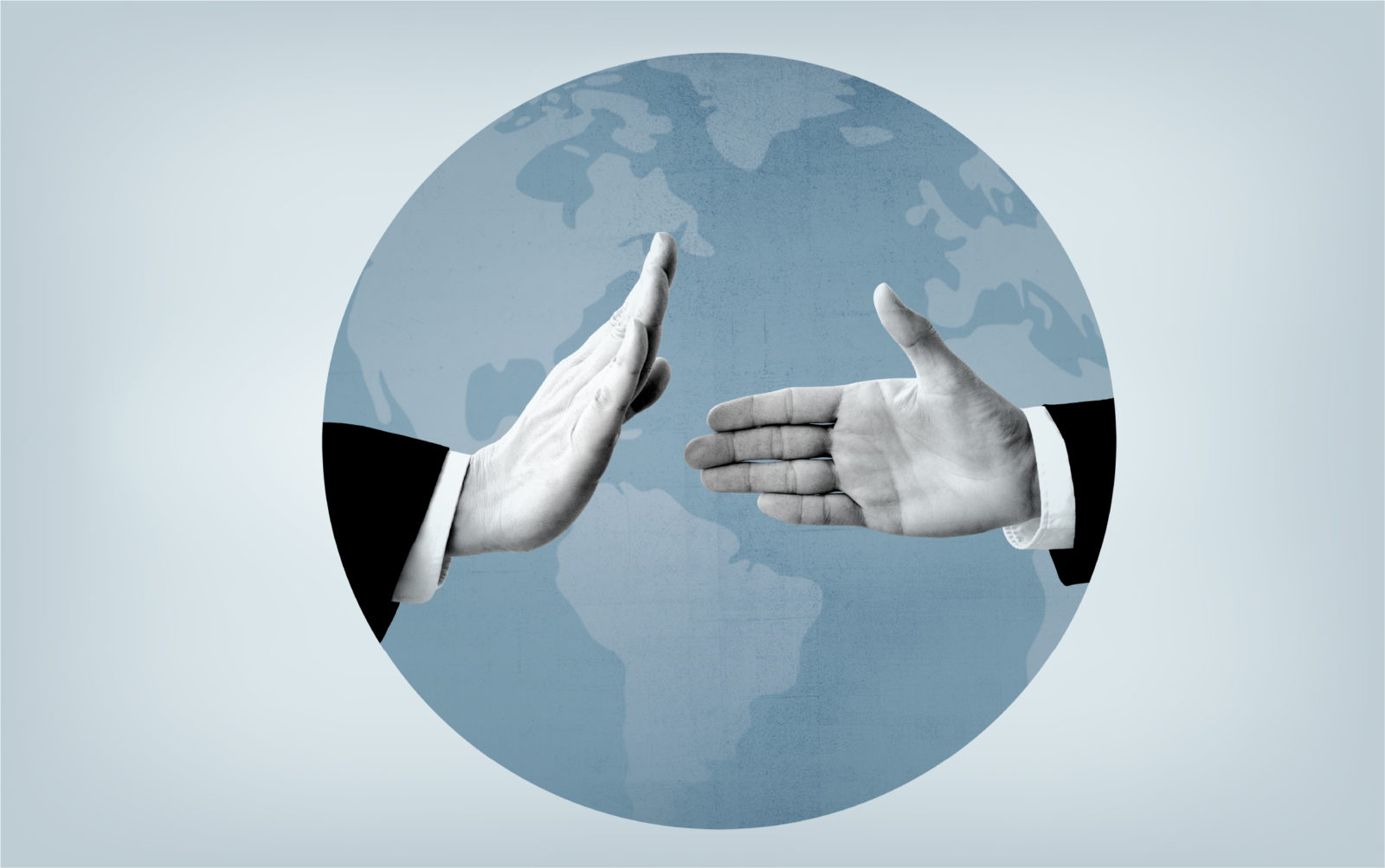
“One year done, three to go.” These are the words being muttered in exasperation by most state leaders and policymakers grappling with the current state of global affairs. In that one year, Donald Trump has left a mark on the world order which may prove permanent, creating more uncertainty and instability than most expected in just a fraction of the time. What distinguishes his second term, however, is not disruption alone, but the extent and normalisation of interdependence as a tool of coercion.
While world leaders are at the World Economic Forum in Davos, for what should be an occasion to discuss strategies that will yield mutual prosperity and stability, leaders have instead been scrambling to react to Trump’s imperialist threats. The likelihood of the United States taking Greenland by force is nearly zero, as Trump outlined in his Davos speech. Even the figures that form Trump’s orbit can appreciate the severe ramifications of such a move. But blackmailing its allies with tariffs for backing Denmark and its self-governing territory is not considerably better.
And although Donald Trump has stated those tariffs will not go into order, this diplomatic crisis remains just that: a crisis. The damage of Trump’s second term has already been done, and is only accelerating. In just one year, his use of economic integration as a weapon (similar to what Russia did with its energy) is forcing America’s allies to choose between maintaining their unwavering allegiance to the United States and seeking new opportunities that better serve their interests.
Canada, for example, one of the U.S.’s closest allies, is already facing the reality of its messy decoupling with the United States, as it travels the road to greater autonomy. Tasked with steadying an economy already under immense pressure, Prime Minister Mark Carney has moved to re-engage Beijing, becoming the first Canadian Prime Minister in nearly a decade to do so, resulting in a significant trade deal.
This is the ultimate result of Donald Trump’s foreign policy, and Europe will be caught in the same structural dilemma. Perhaps the most recent dispute over Greenland will pass and some deal will be reached that grants more-favourable U.S. access to the territory. Perhaps this will even come without further tariff threats on allies or the EU needing to launch its Anti-Coercion Instrument (AKA “trade bazooka”) that would further push the markets to the brink. But as Trump continues to manufacture one international crisis after another, the reality is that the U.S. is increasingly being perceived as an unreliable partner.
The outcome of this, as was the consideration of Prime Minister Carney, is that countries may begin to view China as more predictable. None of this guarantees that China will remain so, and an attack on Taiwan would instantly reverse this assessment, equal to Russia’s invasion of Ukraine. But at least, for now, state leaders may perceive that they can at least predict China’s next move, more than they can Donald Trump’s.
The European Union will of course resist. But, as is the daily reminder for Canada, trade wars are costly and not sustainable for middle-sized countries. This was the sense of urgency that Carney understood when he took the decision to unfreeze relations with China. Under the new strategic partnership, Canada will allow up to 49,000 electric vehicles to be imported per year (reaching upwards to 70,000 in five years) with a 6% tariff, down from the previous 100%. In exchange, China will reduce tariffs on Canadian products, such as canola oil (from 85% to 15%), and remove anti-discrimination tariffs on Canadian seafood and other agricultural exports. The move comes at a time when the economic fragility of Canada is particularly heightened, considering that the CUSMA (Canada-U.S.-Mexico Agreement) is nearing review.
While the Canada-China deal itself is not particularly monumental, the evolution is. Both Xi Jinping and Carney spoke of a reset of relations and framed it as the beginning of more to come. And though the threat of further economic integration with China is equally fraught with risks, being caught between the U.S. and China will force every head of state’s hand to make some very difficult, risky gambits. It is certainly a tightrope that Canada will need to walk carefully, so that it does not simply trade one hegemon for another.
Thinking long-term, Trump’s time as President will eventually conclude. But considering that America has elected him as their leader twice, and its institutionalised checks and balances have so far seemed incapable or uninterested in restraining him, it may take decades before allies put their trust in the U.S. to the extent that they had before.
Herein, the Canadian Prime Minister raised an excellent point. In his speech at Davos, he stressed that “middle powers must act together, because if we’re not at the table, we’re on the menu. Negotiating bilaterally with a hegemon leaves them weak and at the mercy of whatever is offered. The so-called ‘rules-based international order’ no longer functions as advertised; today, the most powerful pursue their interests using economic integration as a weapon of coercion.”
In today’s geopolitical context, this rightly points out that no middle or small power country should – or can afford to – become dependent on another hegemon, whether it be for security, economic or social well-being. The danger now may not be choosing between Washington and Beijing, but mistaking necessity for strategy. In a world where integration can lead to coercion, autonomy — not alignment — may be the only sustainable path.
ENJOYING THIS CONTENT?


-
Reset or Restart? Andy Burnham’s EU Challenge – Bridge the Channel
Bridge the Channel
27 Jul 2026
-
Decoding Sovereignty, Defence, Competitiveness: Democratic Resilience as the Key to Success
Blog
27 Jul 2026
-
“The Iran Knot”: How the War Exposed Italy’s Middle Power Dilemma
Blog
06 Jul 2026
-
Defence Readiness 2030 Requires More Than Higher Defence Spending
Blog
23 Jun 2026
-
Europe Cannot Afford Irrelevance and Must Facilitate Dialogue with Iran
Blog
15 Apr 2026
-
Is UK’s cautious Iran’strategy paying off? I Bridge the Channel Ep.23
Bridge the Channel - Multimedia
30 Mar 2026
-
Iran’s Attacks on the GCC: A Strategic Opening for Europe
Blog
13 Mar 2026
-
China, the EU… and Starmer’s Future I Bridge the Channel Ep.22
Bridge the Channel - Multimedia
25 Feb 2026
-
Values-Based Realism and Its Enemies: How to Tackle the new Geopolitical ‘Realism’ from Left and Right
Blog
24 Feb 2026
-
Elections in Japan: What Takaichi’s Supermajority Means for Strategic Realities in the Indo-Pacific
Blog
10 Feb 2026