

Strengthening European Societal Resilience Under Russian Hybrid Pressure: Lessons from Ukraine
23 July 2026
Russia’s war against Ukraine has demonstrated the Kremlin’s growing focus on targeting societal resilience rather than military forces alone. In Ukraine, since 2014, the Kremlin has deployed a broad spectrum of hybrid tools, including disinformation, cyber disruption, and sabotage, later supplemented by sustained missile and drone attacks on civilian infrastructure alongside conventional military operations. What Moscow initially used at the tactical level has evolved into a sustained, industrial-scale system aimed at exerting continued pressure on Ukrainian critical infrastructure and the civilian population.
Within this broader hybrid toolkit, sustained missile and drone attacks have emerged as one of the most socially disruptive and least prepared-for elements of Russian strategy. Ukraine’s experience shows how repeated aerial strikes, alerts, blackouts, and infrastructure disruptions impose continuous pressure on daily life, governance, and public trust. Even where military defences mitigate physical damage, Ukraine remains exposed to prolonged disruption, uncertainty, and fatigue.
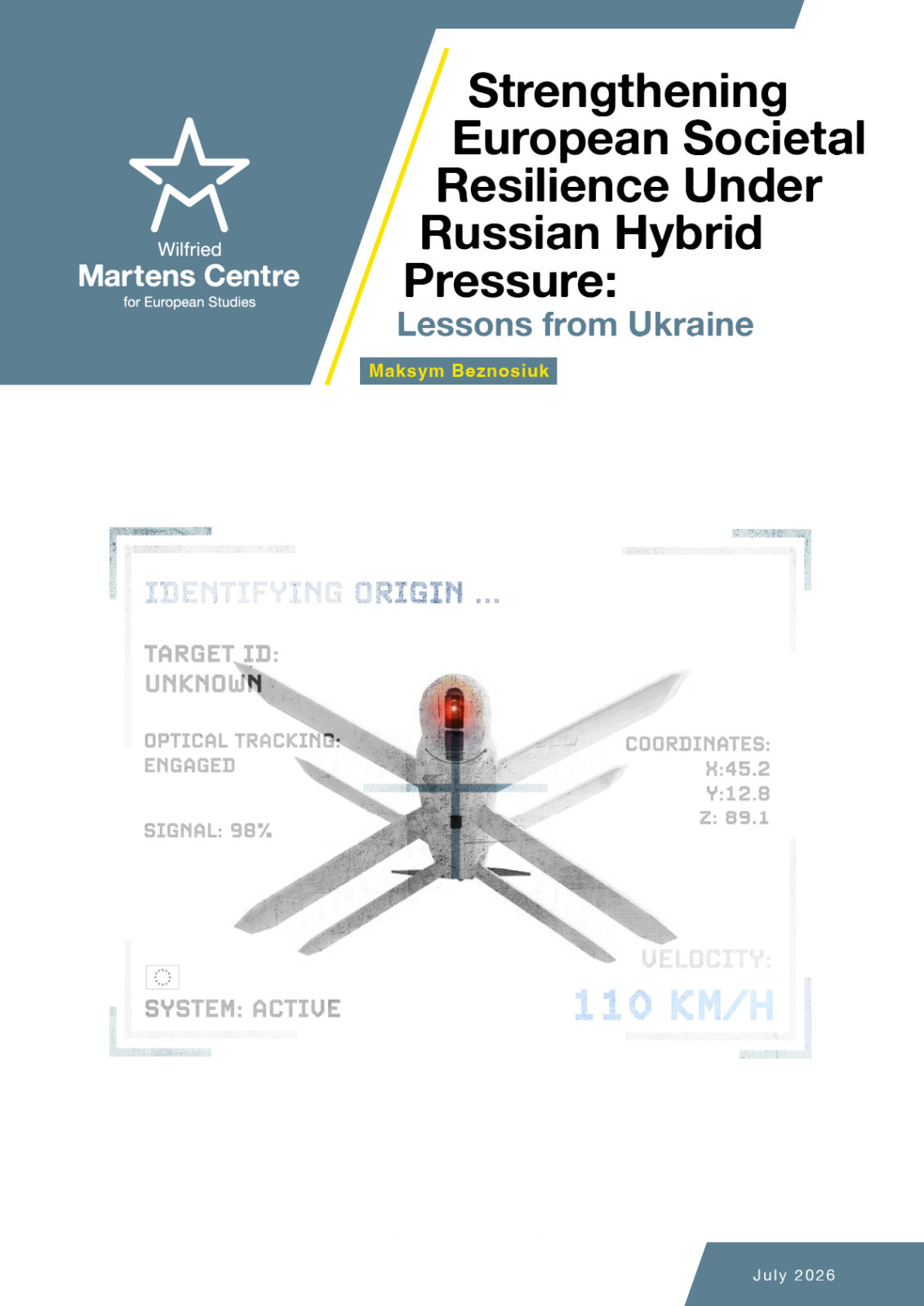
In Europe, the Kremlin has used its hybrid toolkit, including a recent wave of drone penetration of European airspace below formal escalation thresholds aimed at undermining social cohesion and support for Ukraine. The Kremlin deliberately leverages hybrid tools to place sustained pressure on civilian endurance, societal adaptation, and governance, posing grave challenges not only for Ukraine but also for Europe. Ukraine’s experience indicates that prolonged Russian drone pressure is likely to remain a long-term security threat for the entire European continent. These attacks interact with disinformation, cyber incidents, and sabotage, amplifying fear, uncertainty, and political hesitation.
The recent wave of hybrid incidents across Europe, including sabotage, disinformation campaigns, and airspace intrusions, has revealed persistent vulnerabilities. Among them are uneven preparedness, fragmented crisis management, and limited political awareness of societal resilience as a security issue, particularly given that escalation can occur below the threshold of conventional military attack and with little warning. The challenge for Europe is therefore not only one of national preparedness, but also of coordination, shared threat recognition, and institutional alignment in response to transnational hybrid pressure.
As European debates increasingly focus on hybrid threats and democratic resilience, there is a clear need to examine how societal vulnerabilities are targeted, how Russia combines and adapts different hybrid tools, and why Russian aerial pressure is especially disruptive. Addressing both the nature of the attacks and the measures required to enhance resilience is essential to strengthening Europe’s societal preparedness and its ability to sustain the functioning of critical infrastructure, public authorities, and society at large under prolonged hybrid pressure from Russia.
This paper will examine how Russia deliberately targets societal vulnerabilities as part of its hybrid strategy, with sustained aerial pressure emerging as one of the most socially disruptive components of this toolkit. Using Ukraine’s experience as a case study, the paper will assess what this reveals about Europe’s societal vulnerabilities and exposure to hybrid pressure, particularly aerial hybrid threats, and identify key measures to enhance European societal resilience and coordination.
ENJOYING THIS CONTENT?
Stay up to date by joining our database !