


Armenia’s Elections: A Historic Turn Towards Europe?
08 June 2026



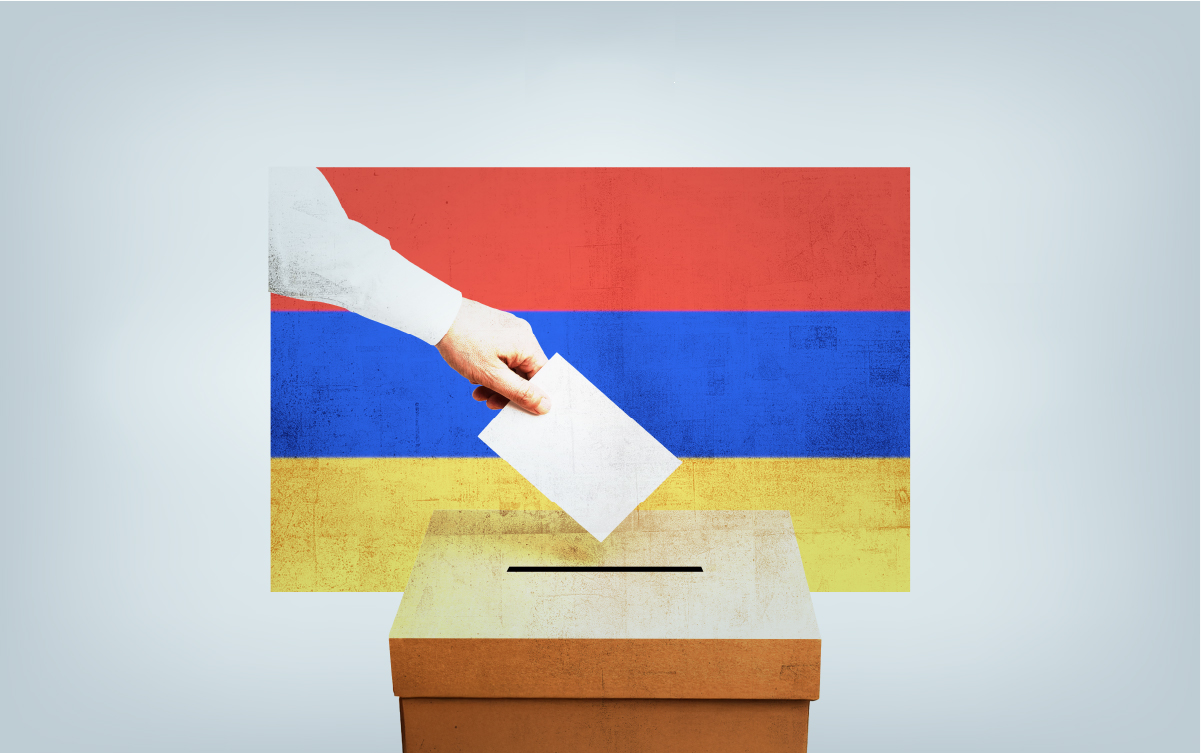
Yesterday, Armenians went to the polls in an election watched closely across Europe and the wider transatlantic community. This was not simply another parliamentary contest. It was Armenia’s first regular election since before the 2020 Nagorno-Karabakh war, and the first nationwide vote after the full loss of Nagorno-Karabakh and the exodus of its Armenian population in 2023.
Prime Minister Nikol Pashinyan’s Civil Contract party again emerged as the largest political force, securing just under half of the vote, around 49.8–49.9 percent. Three opposition forces also crossed the parliamentary threshold: Strong Armenia, with around 23.3 percent; the Armenia Alliance, with around 10 percent; and Prosperous Armenia, with around 4 percent. According to preliminary seat projections, Civil Contract is expected to hold around 64 seats in the 105-member parliament, followed by Strong Armenia with around 29 seats, the Armenia Alliance with around 12, and Prosperous Armenia with around 10, pending final confirmation. Civil Contract is therefore likely to remain in government, but the result points to a more contested political landscape than in 2021, with a stronger opposition presence and a less dominant ruling party.
The result does confirm Armenia’s gradual movement away from Russia and towards closer cooperation with the European Union and Western partners. This is undoubtedly good news for Europe. Yet it would be premature to describe it as a definitive geopolitical realignment or an irreversible European choice. Armenia’s path towards Europe remains constrained by economic dependence, domestic polarisation and the need to balance between competing external powers.
A Mandate for Diversification, Not Decoupling
Armenia’s foreign policy shift is not driven by ideological hostility towards Russia, but by a deep loss of confidence in Moscow as a security guarantor. Russia’s failure to prevent Azerbaijani advances in 2020 and 2023 fundamentally changed perceptions in Yerevan. Since then, Armenia has sought to diversify its partnerships through closer cooperation with France, the United States, India and the European Union.
Yet this is not a clean break with Moscow. Geography, economics and security considerations make a full rupture unrealistic in the short term. The election therefore gives Pashinyan a mandate for continued diversification, not for decoupling from Russia.
The most immediate constraint is economic dependence. Russia remains Armenia’s largest economic partner, while trade, investment, remittances and financial flows continue to bind the two countries closely. Armenia is also heavily dependent on Russian energy supplies and infrastructure, including natural gas and the Metsamor nuclear power plant. These links make any abrupt deterioration in relations with Moscow economically and socially costly.
The second constraint is domestic polarisation. Civil Contract retained power, but opposition parties advocating closer ties with Russia and rejecting Pashinyan’s course secured a significant share of the vote. Pro-Russian and nationalist forces therefore remain politically relevant.
This polarisation is not based on traditional left-right divisions. It revolves around security, identity and foreign policy. Supporters of the government see closer ties with Europe as part of democratic reform and strategic autonomy. Opponents portray European integration as linked to concessions towards Azerbaijan, the weakening of traditional alliances and threats to national identity. Border demarcation, relations with Turkey and the peace process have all reinforced these tensions.
Finally, Pashinyan’s victory should not be mistaken for overwhelming enthusiasm for a European agenda. His success also reflects the weakness, fragmentation and discrediting of the alternatives, including much of the pro-Russian opposition.
Many voters appear to have viewed Civil Contract as the least problematic option rather than as the embodiment of a transformative national project. The election therefore confirms support for continuity, but not necessarily the emergence of a consolidated pro-European identity.
A Strategic Opportunity for Europe
The election nevertheless presents an important opportunity for the European Union.
Armenia is actively seeking to diversify its external partnerships while pursuing democratic reforms and closer engagement with European institutions. This creates space for a stronger EU role in the South Caucasus. But Europe should not mistake momentum for inevitability. Armenia’s future foreign policy will likely remain shaped by balancing rather than full alignment.
This is precisely why EU engagement matters. Economic dependence, domestic polarisation and regional insecurity will continue to shape Armenia’s room for manoeuvre. If Europe wants Armenia’s European trajectory to become more sustainable, it must offer more than political encouragement. It needs a practical agenda built around economic resilience, energy diversification, connectivity, institutional reform and support for Armenia’s sovereignty.
Armenia’s experience also points to a broader lesson for European policymakers. In the eastern neighbourhood, geopolitical choices are rarely made in a vacuum. Historic ties, economic structures, energy links and security dependencies continue to shape what is politically and practically possible. A successful EU approach must therefore combine ambition with realism: supporting Armenia’s gradual transformation while recognising the constraints under which it operates.
The 2026 elections have opened a window of opportunity. Whether they become a historic turn towards Europe will depend not only on Armenia’s choices, but also on Europe’s willingness to act strategically in one of the continent’s most complex neighbourhoods. The EU already has many of the necessary tools at its disposal, including the new EU-Armenia Strategic Agenda, the Resilience and Growth Plan, the Connectivity Partnership and the Global Gateway framework. The challenge now is implementation. By accelerating economic integration, supporting connectivity and energy diversification, expanding mobility opportunities and maintaining its role in the peace process, the EU can help make the European option more tangible for Armenian citizens.
Armenia is moving closer to Europe, but it is unlikely to abandon its balancing instincts overnight. The EU’s task is therefore to make the European option more credible, more tangible and more resilient over time. Ultimately, a successful European approach towards Armenia will require not only a coherent South Caucasus strategy, but also a clear understanding of how to manage Russia’s enduring influence across the EU’s Eastern Neighbourhood.
ENJOYING THIS CONTENT


Related publications
-
Strengthening European Societal Resilience Under Russian Hybrid Pressure: Lessons from Ukraine
23 July 2026
-
EU Connectivity Under Pressure: The Iran War and the Geopolitical Reconfiguration of the South Caucasus
12 June 2026
-
Dark Mirror: Transnational Populist Networks and the Construction of a Parallel International Order
25 May 2026