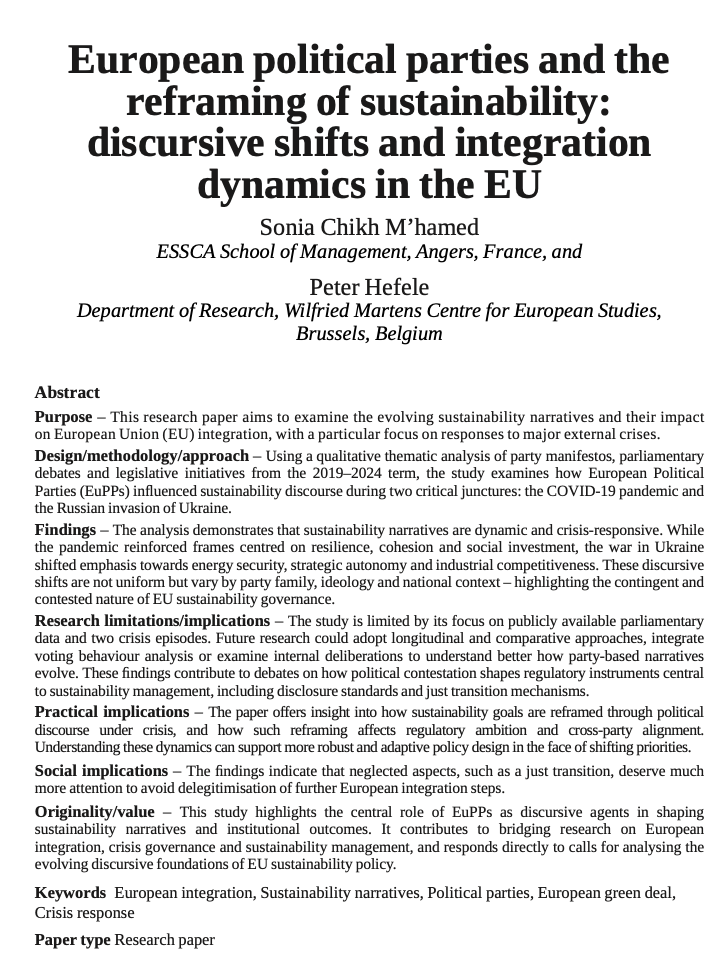
European political parties and the reframing of sustainability: discursive shifts and integration dynamics in the EU
09 January 2026
The European Union’s approach to sustainability has changed in recent years, especially during major crises such as the COVID-19 pandemic and the war in Ukraine. An analysis of the political debates in the European Parliament shows that sustainability in the EU is not a fixed idea. It changes depending on political priorities, public pressure, and external events.
During the COVID-19 pandemic, sustainability was mostly linked to recovery and solidarity. EU leaders presented green and social investments as a way to rebuild the economy, protect jobs, and strengthen public services. Sustainability was about making societies more resilient and better prepared for future shocks. The focus was on investment, support for vulnerable groups, and modernising economies.
After Russia’s invasion of Ukraine, this focus shifted. Sustainability became closely tied to energy security and independence. Reducing reliance on Russian gas, securing energy supplies, and supporting European industry moved to the centre of political debate. Climate goals remained important, but they were increasingly discussed in relation to competitiveness, affordability, and strategic autonomy.
Political parties do not all understand sustainability in the same way. Green and left-wing parties tend to stress environmental protection, social fairness, and strict rules. Centrist parties often focus on innovation, technology, and making the green transition work for businesses. Right-wing and nationalist parties are more concerned about national control, energy sovereignty, and the cost of regulation. Because of these differences, EU sustainability policies are the result of compromise rather than a single shared vision.
EU funding is now closely linked to sustainability goals. Access to recovery funds and energy programmes increasingly depends on whether projects respect environmental and climate criteria. For public authorities, this means sustainability must be built into projects from the start. For businesses, it means that green requirements are becoming part of everyday economic decisions, not just long-term plans.
Some politicians worry about the burden on small and medium-sized businesses. As a result, reporting and compliance rules are being simplified in some areas. However, the overall direction remains the same: sustainability expectations are here to stay, even if the details change.
Several clear lessons emerge from this analysis. Sustainability policies need to be flexible enough to work in times of crisis. Social fairness should not be pushed aside when security or economic issues dominate the agenda. Rules should be ambitious yet realistic so as not to create unnecessary resistance. Finally, sustainability should be presented as part of Europe’s strength – helping to secure energy, protect citizens, and support economic stability.
Political choices shape sustainability in the EU. Understanding these choices helps explain why policies change over time and why sustainability remains a central, yet contested, part of Europe’s future.\