

A South Korean Warning on the Perils of the AI Economy
01 September 2026



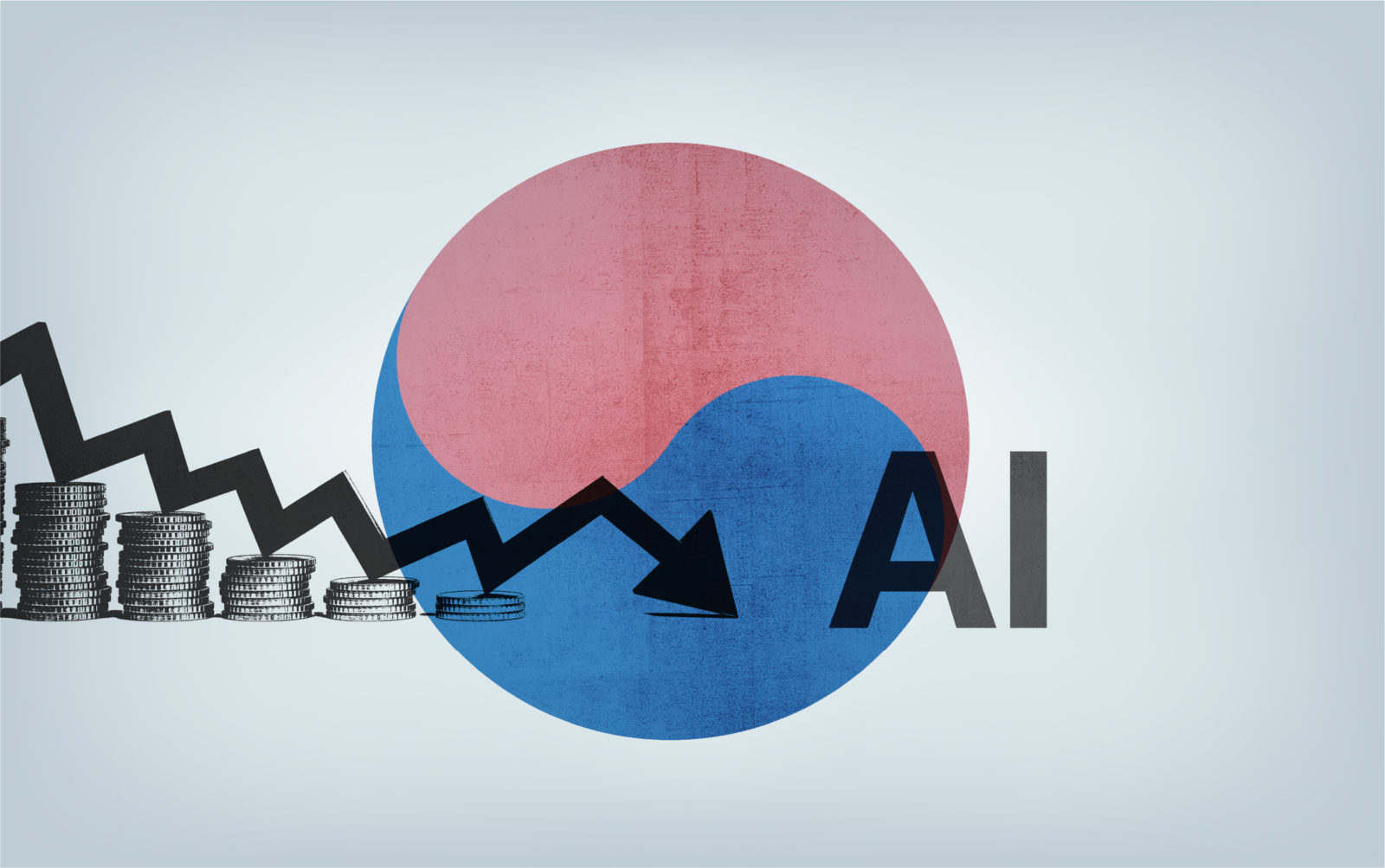
Although barely reported in Europe, South Korea has just experienced a terrifying glimpse of how AI stocks increasing market dominance – coupled with modern trading technology and lax financial regulations – can cause extreme volatility and wealth destruction.
The South Korean stock exchange (KOSPI) doubled in value between January and June 2026 before plummeting by nearly 40% over the following month.
Although designed to represent the entire South Korean economy, the KOSPI had come to represent a one-way bet on the AI boom. Over 50% of the entire index was represented by just two firms – Samsung and SK Hynix. But this wasn’t a bet on TV’s and high-end electronics – no, this symbolised a wager on these companies’ critical roles in providing High Bandwidth Memory (HBM) chips and other data centre hardware to the AI juggernaut.
This is a classic example of over-concentration risk. And one which the United States would do well to heed. Already, AI-linked stocks account for around 45% of the S&P 500’s total market capitalisation. And this is before companies such as OpenAI and Anthropic even list on the US exchanges!
Even more worrying is that existing AI ‘Hyperscalers’ (technology companies that provide global networks of data centres) now dominate earnings and debt flows. Just three Hyperscalers —Alphabet, Amazon, and Meta — are responsible for roughly 70% of the S&P 500’s entire earnings growth expectations. Hyperscalers alone have borrowed over $220 billion so far in 2026 to finance their AI ambitions.
Yet, it’s not just concentration risk that should keep global policymakers awake at night.
The South Korean example also highlights how modern trading technology – the ability to trade instantly on your smartphone has pitfalls for millions of ordinary (and often not fully informed) investors. As noted by the Wall Street Journal, “more ordinary Korean investors joined the frenzy, including stay-at-home mothers, students and retirees cashing in their pensions. Many newcomers became stock-rich almost overnight. Margin loan balances rose by $7.9 billion to $27.1 billion in six months, as more investors tried to boost returns”.
Amplified by social media, local retail investors, known as “ants,” used online coordination and debt to pile into Exchange-Traded Funds (ETF) that were based not just on the investors’ initial investment, but also included a borrowed component. These ‘leveraged ETFs’ often use more complex financial instruments (such as derivatives) and debt to multiply the daily returns of an underlying index or asset. In reality, these products magnify both gains and losses – and thus provide a poor substitute for a sustainable, long-term investment strategy.
The Korean boom-and-bust cycle was also fuelled by direct political amplification. ABC News Australia described it succinctly: “the South Korean government contributed to the 2026 stock market crash by aggressively encouraging retail investment and loosening regulations on debt-financed trading products just as a speculative tech boom reached its peak”.
This lack of regulation was directly associated with South Korean President Lee Jae Myung’s desire to erase the traditional discount attributable to South Korean stocks compared to global peers. This so-called “Korea discount” has traditionally been based on corporate governance concerns concerning the complex ownership structures of the large conglomerates which dominate the South Korean economy.
Central to this strategy of increasing domestic stock market investment was the popularisation of leveraged ETFs. The results, as we have seen, have been a traumatic (and expensive) lesson for millions of South Koreans.
In a wider context, it’s clear that AI stocks (or stocks basing their future earnings on the continued stratospheric growth of the AI ecosystem) pose a fundamental risk to global macroeconomic stability. This risk is exacerbated by rapidly expanding public and private debt levels, such as in the United States.
South Korea also shows that this economic risk is magnified when combined with modern trading technology, lax regulation of available financial products, and limited financial literacy among the wider population.
Perhaps also, the volatility in Korea highlights the susceptibility of huge swathes of the population to investments promising immediate and incredible returns. This is at least partially attributable to the increasing disconnect felt in most developed societies between social mobility and earned income. For many lacking inherited family wealth, the roulette of poorly understood investments remains a potential pathway to the traditional middle-class dream of economic security.
Europe will not be immune to the contagion caused by interlinkage of AI, debt and often antiquated financial regulation. We would do well to heed the South Korean warning.
ENJOYING THIS CONTENT